



Previous episode with Extras:


One of Tulubaikaporia’s features is it can be read episodically in random order skipping some of the episodes and still be enjoyed and understood at that layer. There’re, however, more and more layers!
In the introduction to “The Teacher of Symmetry”, which is framed as a translator’s commentary to the text translated from other language, Andrei Bitov, the author, writes this:
Each chapter of “The Teacher” can be read as a separate work; the reader is free to give preference to one or another as an independent story, but if they masters all in succession and hear the echo spreading from the previous to the next and from each to each, then they will discover its source, that is, they will read the novel itself, not a collection of stories.
We only discovered it in the late stages of writing Tulubaikaporia but it does seem to describe its organising principle perfectly, a principle that isn’t at all foreign to contemporary Russian literature as you can see.
The story today is one of the first written for the cycle and one of the few written in English. It’s also one of our all time favourites! And it can indeed be read as a separate story.
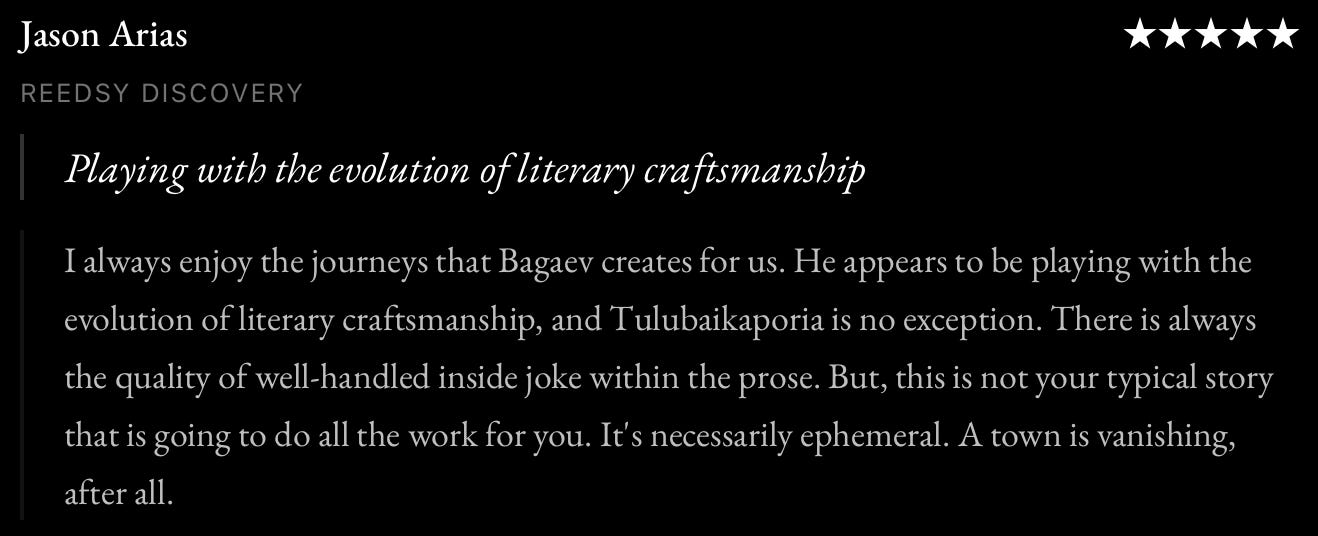
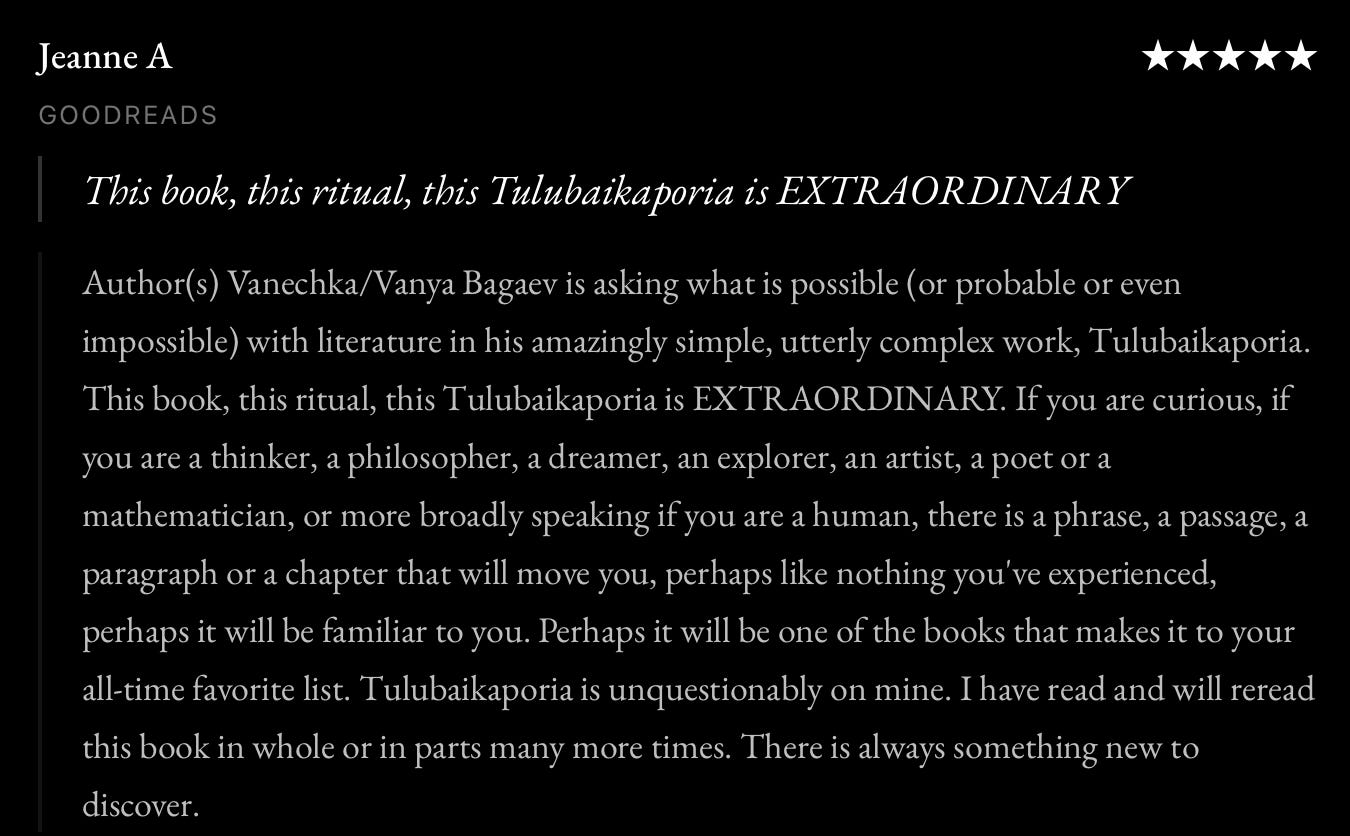
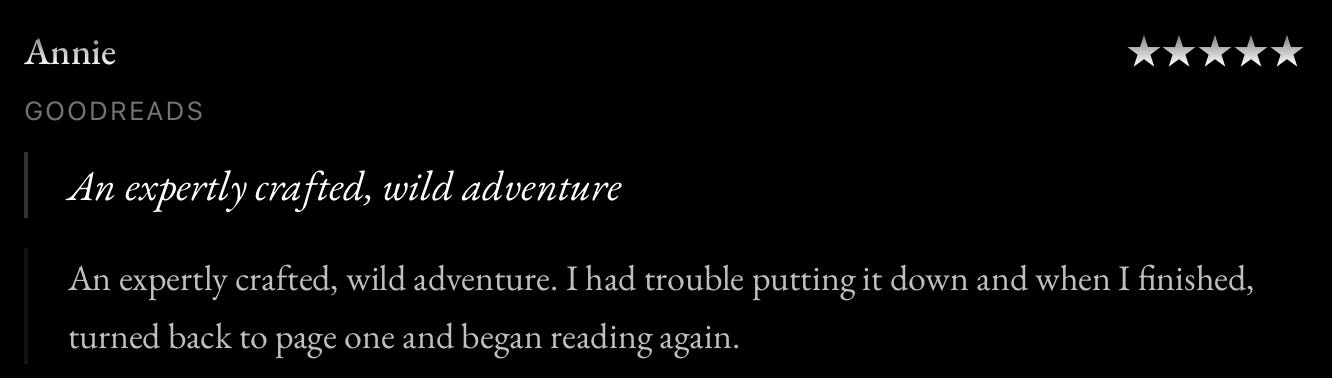
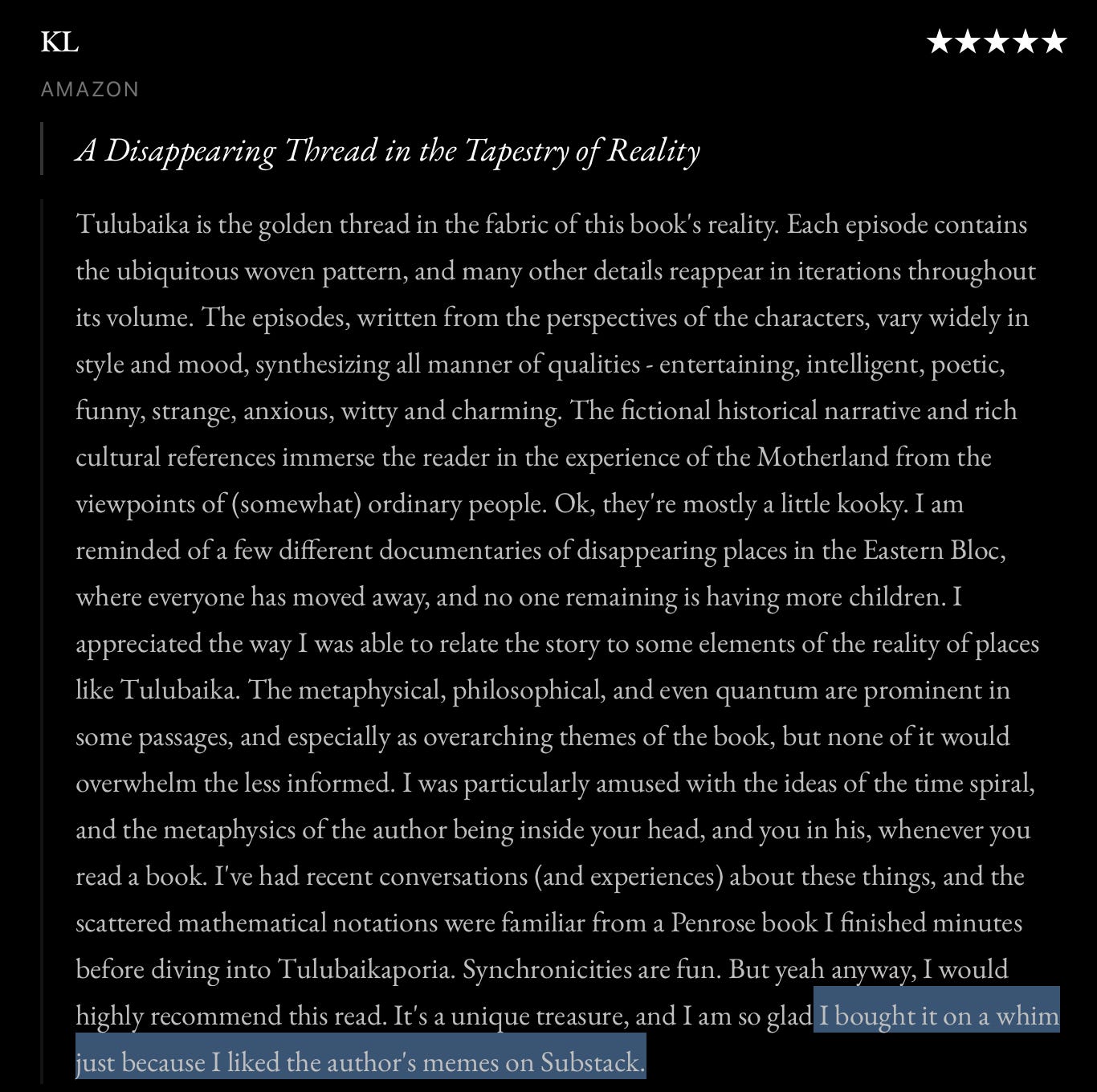
Meanwhile, new reviews:
Read this story for free on nova-nevedoma.com · Download PDF
“I am a myth. And you create it.“
— “Palisandria” by Sasha Sokolov
Among the timber tables run decrepit demon dogs, all ulcerated, their mouths bleeding, bubbling with an alabaster foam. I couldn’t care less about them, though. There’s me and there’s her, though for me, there’s only her, my heroine; nothing else matters, not even these weird creatures. The air smells of candle wax and balsamic vinegar someone has spilt at the table next to us. While the demon dogs are dead set on pinching anything off the tables, while the copious happy people around mumble, while the fish-headed waiters shout at each other in an unrecognisable tongue, while somewhere in the bushes right behind the restaurant cicadas compose a cacophonous lullaby, while branches of yew with red holey beads scratch the plexiglass roof of the terrace, my heroine, only my heroine, remains the sole focal point into which my decaying reality funnels, and while a fly drowns in my wine, I drown in her iridescent eyes. Those round, furtively blinking orbs are either grey, the hue of smoke or a thick morning fog, or green, the hue of jade, possibly faded a tad from overexposure to overattention. Around her dilated pupils, a ruby lattice of tiny capillaries has grown; masterful jewellery, her eyes now. Is this the third bottle this evening? C₂H₅OH and some other substances; the transmutation of the evening into the—
— This is secret ingredient of transmutation from evening into night, — my heroine says in broken tongue.
— What kind of ingredient, though?
— Secret ingredient.
— O-o-oh, I see. A secret ingredient.
— Secret ingredient, yes. You know what that mean?
I shake my head, lips arched up.
— This means I not tell you what is this. Did you think I tell you?
— You must tell me, though. My mother taught me not to take strange substances from strangers, especially strangerettes, which perfectly describes the situation I’m in right now.
— I understand. Mother word is law.
— I wouldn’t ask otherwise.
— Well, too bad, I still not tell you. Somewhere, somewhen, I am someone’s mother. Therefore, on a grand scheme of things, my word is law, “though”.
My heroine stretches a sly smile and takes a sip from her glass.
— But not now?
— You are so fixed on “now”. I not— I don’t understand.
My heroine keeps staring at me. She doesn’t blink, or perhaps we blink at the same time. It happens sometimes; people blink at the same time and never see each other with eyes shut, or blink in turns and never see each other with eyes open. I try to blink unevenly, at random times, so that doesn’t happen, but still never see her eyes shut. It is a state-of-the-art mesmerisation, no more, no less.
— I am. I won’t argue with that.
— Well, then don’t. Simple, da1?
— I won’t, but I thought it would benefit the evening a little bit and perhaps speed up the “transmutation” process if we build some trust.
— Such silly thing to say! I trust you. You’re crazy and naive enough to take pills from “strangerette”. You’re harmless. Harmless people trust everyone, you did that, so I think you “trust” me, in odd way. But why it matters?
A faceless waiter with five eyes, a peaky nose, and a Cheshire mouth under a Dali moustache walks by carrying on a plate a festering dog head sprinkled with parmesan and basil, the aroma of which overpowers the dog’s smell, as if it were pasta.
— Well...
— If you are afraid from falling, then fly. Or baituut. We said this in my village.
— Doesn’t make any sense to me, I’m afraid.
— You shouldn’t be afraid. You should turn on brain. Make it think, da?
— I’m afraid of “turning it on” to think about something like that.
— You see? You not understand. Risk of falling is not real if you already falling. It is in past and it is zero percent and hundred percent in same time, which in reality means it not relevant, which then means it not exist. Flying, on other hand, is w-a-ay more risky because risk of falling is still not zero — you can just fold wings! That is that.
— Didn’t know you were a risk manager.
— Maybe I am. Maybe I am not. I prefer to stay a strangerette. Maybe I will poison you, rob you, give you syphilis or something worser.
— Do you do that to many men?
— No, only to pretty ones. Rest I just rob.
— So I’m in grave danger then.
She scans me, head to toe, as much as the table between us allows, shrugs.
— Nah, don’t worry. I think you very safe.
— Very safe?
— What, I say not correct?
— No, I just thought I’d come back home with syphilis. I already dreamt of that.
— Well... no?
— I’m thankful.
— You should be.
— So, tell me, am I flying or am I falling?
— We will understand this soon.
On the porcelain plate right in front of me lies a slightly charred squirming tentacle of an ancient god, drizzled with saffron aioli. Shoggoth? Yog-Sothoth? I don’t want to know. The suckers on it stare at me by the hundreds of tiny eyes, not with pity, not with interest, but rather with irony, as if the tentacle is about to eat me: jump off the plate, wrap around my neck, squeeze until it cracks, and then, when my last breath leaves my lungs, crawl into my brain through a nostril and occupy my body.
— Maybe we should do it in the hotel.
She scratches her chin.
— Why?
I expect her to add “I do wonder” but she’s silent. My brain has started finishing her lines long ago.
— No, I mean... I am afraid I will start doing weird things soon.
— Weird things? For example?
— I wish I knew in advance, but no, I don’t know. Just weird things, stupid things, things you won’t like and I will regret...
— You have previous experience of doing weird things? I could make prediction about it. Maybe there’s trend...
— Are you an analyst now?
— Maybe I am an analyst...
— Like... I could start fighting with the waiters and then they would throw me in the canal and I would drown in there and die.
— No worry, I will pull you out from there. Did that happen before?
— Except the last part. Though I’m not sure about that sometimes... You don’t like your oysters?
Twenty rock oysters rest on the mountain of ice right in the middle of our table. My heroine’s order, untouched.
— I never ate oysters.
— You haven’t? I don’t eat oysters. They sometimes...
Here I think of how oysters, upon entering my body, would try to occupy it too, and I myself become an oyster, waking up in a rock shell the following morning.
— Well, I won’t spoil it for you.
— How do you eat them?
— You just, um, slurp.
— Slurp? What is slurp?
I kindly demonstrate the slurp sound.
— Ah, “slurp”. Okay.
Multiple signs of cunning surface on my heroine’s face: a smile, a squint, a long, thorough lip lick. She plots and executes, my heroine: takes an empty tap water glass, takes an oyster and pours it into the glass, setting aside the shell.
What are you doing?! I could’ve asked, but my curiosity suggests not to ask stupid questions and prefers to observe. My heroine takes a second oyster, a third, a fourth, ..., ..., until they all end up in her glass. Then, as I expected, she drinks them all (!), just like that, in one big slurp. Impressive. Somewhere in the back of my mind, one of my thoughts is already looking for where nearby one could buy an engagement ring in the middle of the night.
— What? — my heroine asks, a slight shyness in her posture.
— No, nothing. I am, well, I am, I must say I’m rather impressed.
— Rather?
— Rather, yes.
— I did something wrong?
— No, you did everything perfectly. Not sure I’ve seen anything closer to perfection.
— I can read irony.
— I know you can, that’s why it wasn’t irony.
My heroine smiles.
Next to us, in the artificial river locked into three walls of brick and concrete and one wall of light-polluted city atmosphere, among dark green algae, cigarette butts, and crumpled cans, a school of fish learns to fly. Do they fly or do they think they fly? Or do they fall horizontally? What do the fish feel at this moment? Where are they going so free, so aimless, so hopeful? Straining their fins, they travel to the spawning grounds where they, like zergs, in sin, will multiply in quantity, and then come back to hooks and nets, to fridges and freezers, to pans and plates, to fish and chips, to someone’s mouth. Mine perhaps. Or my heroine’s. Her pink lips, glistering with grease, unfold like an orchid in bloom and her red tongue licks the tartare sauce from her knife and her... Wait! My parents taught me never to lick a knife. It brings bad luck, it’s tempting fate, it’s bad etiquette, it’s basic sharp object safety. But she... For her... For her it’s a transference of energy or life force of the knife’s victim to the person licking it. She lovingly pierces a chip with her fork and starts chewing it, her sharp jawline going in zigzags. She is a rare species of orchid-flycatcher and I’m a not-so-rare species of fly who can’t decide between flying and falling. I can feel her chewing my head off with glee, or rather neutrally, in a manner of habit. My skull cracks open like a chocolate egg and the brain yolkly tries to escape this tragic transgression yet fates out like the fish. Then my heroine picks up a dried bucatini from her cocktail and, using it as a straw, performs one rapid succinct sip from my skull — *slurp!* — it’s gone! I’ve lost my head, I’ve lost my brain, I’ve lost my mind — I’ve lost everything.
— You never said it was so strong.
— You never said you were so weak.
— I’m not weak. I’m vulnerable to deception and drugs, like anyone else.
— Well, I am not vulnerable to whatever.
— Of course you’re not... You seduced me, fed me your weird pills and now my mind is melting. I see things I wish I couldn’t see. I think things I wish I couldn’t think.
— That is good description of my whole life. Strange that you need pills for that. What are you?
— I feel like, erm... (I wouldn’t tell her I saw her eating my head. That would ruin the romantique) My brain is made of malleable paraffin and it’s melting now, trying to escape this tragic transgression but fates out like the fish and my fish-fate appears predetermined, circumscribed by an insurmountable metaphysical aporia.
— Sometimes I don’t understand what you are saying.
— Just listen to the words.
— Is not fun to listen to the words when you can’t understand them, da? I could just listen to cicadas instead. Maybe I understand them better.
— What do they say?
— Cicadas?
— Yes, cicadas.
She scans her surroundings, squints intently, and, shrugging, returns her gaze to me. Those eyes again. I’m disappearing, flopping inwardly.
— Not sure. I don’t know much about Cicadian, or is it Circadian? Anyway, I know it even less than your tongue.
— Do they sing? Can you hear them singing a song?
After a short intermission of silence, the conductor hiding in the vegetation, its tailcoat fluttering in the wind, its eyes closed, its mind concentrated into a single dot, a dot that’s about to explode with music, spreads its little cicadian limbs and, bursting with pompousness, drops them down in one sharp stroke, cutting the air and, who knows, the whole world, the whole universe into two halves. In a fraction of a millisecond (which some oddly label “immediately”), as if the “start” signal was transmitted to them with no consideration of time, telepathically, the cicadian orchestra starts its fierce symphony. Out of nowhere, a series of omnipiercing vibrating shrieks, like those of a spinning chainsaw or aroused starlings, takes over the space. BzzzzzZzzzZ BzzzZZZZzzz BzhzzzzZZzzZZZzzzZzZZZzzzZzzZzzzzzzzz and so on... The orchestra, perhaps, consists of all living cicadas, all cicadas that have ever lived, and all cicadas that will ever live. The symphony, simple yet complex, discordant yet meticulously composed for maximum deafening effect, angelic yet demonic, rhythmic yet arrhythmical, turns the air around us into gelatin. Everyone and everything feels it. Every flower, petal, leaf, grass, poisonous yew berry, every glass and utensil on every table, the plexiglass roof of the terrace, every eardrum, every hair in every cochlea — everything trembles, neither from fear, nor from awe, nor from pleasure, but from belonging to something greater, to something shared, to something universal, as if now the vibrations emanating from the orchestra do not just touch everyone, but merge with them, propagated deep down to the innermost essence of every being and thing. It’s a rock opera. It’s jazz but with a billion “z” at the end of the word. It is a torrent of joy and agony combined into a hitherto unknown bittersweet sensation, a feeling of nostalghia for every fraction of a moment passed and every moment to come. Between the moments, if you tune in, you experience an eerie sense of quiet, like the universe has just pressed the mute button, and you have fallen through into a transient void. You feel its texture. You feel what the world really is, described in the cicadian tongue.
— ... That is how cicadas reveal to us the underlying vibrations of the world — through their music, through their unequivocal art, and they are just humble tree crickets. I can’t imagine what a human could do, — thus I finish my speech.
My heroine bursts into applause.
— Wow, I mean... Okay, it probably was too strong on you.
— Did you hear all my thoughts? The whole thing?!
— Yes, but because you said it out loud. And let go of my hand. I don’t mind it but your grip is just too tight, like a child handcuff.
I remove my hand from hers and look around. The dizziness takes over, and every person on the terrace, every guest and host (no dogs; they are gone, luckily), now has auras comprised of vibrating doppelgängers, their appearances multiplying before my eyes, each body fanning out into a cluster of blurred copies, as if the shutter speed of my mind-camera has gone snail.
— Sorry... Can you say something in your tongue?
— Like what?
— I don’t know. Something. I need to hear something I don’t understand because now, I reckon, I understand too much.
— You are ill? Here, drink water.
She moves her glass towards me and I pour it whole down my throat, together with ice. It feels like embers crawling down my oesophagus.
— We can leave? Have some fresh air.
— No, please just say something. Words, I need words.
— Such as? What do you want to hear?
— I don’t know. Just words. The whole thing I just thought... or said. About cicadas. Translate it to me. Please. I want to hear your native tongue.
— Okay.
I sit straight and look into her eyes. Mimicking everything else around, they multiply into dozens and hundreds as if she’s Argus now. I close my eyes and prepare to listen.
— Erm... well... it’s, ugh, kaiabtuluulbaiakkatu.
She’s silent. The only thing I hear is the cicadian orchestra.
— Wait, that’s it?
— Da.
— Is that what it means? The whole whatever-that-was translates into... that? Just... what? One word? Two words?
— My tongue is very expressive. And it’s not a word, there’s no such concept in my tongue.
— Where are you from?
— It’s called Tulubaika.
— Tooloo-what?
— Tulubaika.
— Toolookai- no... I can’t do it.
— Tu-lu-bai-ka.
— Too-loo-bai-la?
— No!
— I think you’re making it up. The wicked tongue. Everything. It makes no sense.
— No, I don’t. Why make up? World has enough things already.
— Yes, you’re making it up. I can see that in your eyes.
— You think I lie?
— No, not lie. It’s different. You’re making it up.
— No, I’m not. Why would I do that? I can’t invent nothing.
— I don’t know. To play me?
— I don’t play games.
— What was it again? Tooloobulu-something.
She’s laughing, I can feel she’s laughing, inwardly, she’s making fun of me, taking the piss.
— Tulubaika. Is Tulubaika.
— No, it can’t be real. This can’t be serious.
— It’s all very, very serious. Everything is serious.
— I don’t mean to sound impolite but is it some... I don’t know... rare unknown indigenous place? Is that where you are from?
— Tulubaika.
— But what country?
— Asking woman where is she from is worse than asking age, mister. You can guess my accent.
— I don’t know. I’m bad at accents. You’re extraterrestrial.
— Yes, good idea. I like it.
— I mean it as a compliment, by the way.
— I know. Now I say I am alien from Venus. Tulubaika is village on Venus. The only one maybe. How does this sound?
— Alright. I see. Venus. Well... Okay. I mean, why not. Describe it to me.
— Describe?
— Yes. I want to know what it’s like, Tooloobaila, Venus.
— Tulubaika! It is small, very small village, da? There isn’t nothing to describe, “I’m afraid”. It is very quiet and peaceful. There’re fields around and nothing else. We have a few small houses and we have orchid gardens.
— Orchid gardens? For real?
— Da.
— In a village?
— Yes, just one.
— An orchid garden? As in a garden with orchids?
— See? You don’t believe me, whatever I say. You don’t trust me. This is your problem. You must trust people. This is how society work.
— In Tooloobaila?
— Everywhere.
Tilting, I watch her eyes multiplying on her face.
— We’d better get some fresh air.
Along the cobbled path, high above the surface, run four legs, from them two bodies holding hands grow gradually, entwined into one drunken silhouette that chuckles, bursts with laughter — the silhouette’s only language. The words, the real words composed of morphemes with attached hints of meanings and history of the evolution of hundreds of tongues, have ceased to exist, dispersed into individual sounds, and these sounds, in turn, have dissolved into the air like vapour billowing from an air humidifier, and instead of them there now exist only glances, touches, emotions, laughs, the smell of hormones and alcohol, basil and garlic stuck between teeth, the waves of twisted electricity hopping joyfully from neuron to neuron, from brain to brain, liberated, given to themselves. Words are no longer necessary, necessity itself is unnecessary; it simply is, everything simply is. The memory that has been and memory to come, the coordinates of seconds, minutes, perhaps hours, and any sense of continuity are — *snap!* — gone. They are lines on paper filled with numbers and ticks that our brains cannot read. Chronology is not a property of time but a science that studies it, a pseudoscience for pseudopeople.
My heroine’s hand is cold and wet. She smells of wine and sweat. We’re traversing a piazza, a concave square made of thousands of thousand-year-old convex stones polished by time and soles. In the middle of the piazza is a fountain with a statue of Venus. The statue has no head, the head has no eyes and no mouth, the figure has no hands and the hands have no fingers, it has no legs, no torso, nothing, the statue doesn’t even have itself, but it’s still there, visible, looming a few metres high over the piazza, dropping its shadow in all directions, overlooking the paused fountain, now filled with coins from all around the world — tributes to the goddess of love. The gusts of wind soar at the piazza, whistling around us as we escape the space behind us. We’ve abandoned our shoes and every stone in our cobbled path now feels like a little mountain. We’re flying above the mountains, thousands of little peaks, and suddenly hear the mus—
— Sound like someone is beating an elephant! Let’s go and see what is it!
Her hair all over her head, face and shoulders, my heroine pulls my hand somewhere, without waiting for my response.
— Beating an elephant? lol, I mean LOL.
— LMAO even, look!
Before us — an arcade, a long illuminated corridor with beige brick walls and a few dozen glass doors under an arching glass roof. The shops and restaurants are closed and dimly lit, the lights of melon-sized bulbs hanging sadly above empty counters. In the middle of the arcade, a saxophone produces a wildfree melody that its lone player attempts to tame. Her eyes closed, she doesn’t see us, and as we approach her, she keeps blowing, ordering the disorder of the air into melancholic vibrations, an elegant sequence of transient voids exquisitely arranged and timed together, weaving the empty space of the arcade into one single thick thread that leads us to... Where to? No idea. We tighten our collective grip, freeze and listen to the saxophonistess. We feel her wordless speech not with our ears but with our whole bodies as all the little hairs on our napes, hands, and legs rise, after the cold, refreshing, sobering and tickling sensation travels from our eardrums to our toes and fills our whole bodies with ecstatic charge. The song abruptly ends and the saxophonistess gives us a blissful smile.
In unison, we ask:
— What’s the song called?
Frowning, she replies:
— It’s not a song.
In unison, we express our persistent curiosity:
— But what is it called?
Upon a momentary pause, the saxophonistess answers:
— Let it be “A Lament of a Dying Elephant.”
Awed, quite so (myself, especially), we ask again (we must be very annoying):
— Has it died?
The woman seems amused by the conversation:
— Who? The elephant? I don’t know.
She shrugs, and we clarify:
— No, the song.
She’s almost laughing now:
— Ah, probably you can say that. I don’t think I would play it again.
— Why wouldn’t you?
— Because I have no idea or memory of what I’ve just played.
The song has passed from the physical world, for it stopped vibrating it and thickening and entangibilising its fabrics, but in our world, which is far from physical, it still sings. Inside our brains, it’s tattooed as a long sequence of notes, filling every convolution in dense calligraphic graffiti. It is a code, a program, an instruction, a spell, something that’s now running continuously on our joint brainware in a magical, metaphysical manner, despite having no repeated elements that our ears could catch. Hypnotised by (as everyone agreed) “A Lament of a Dying Elephant”, we dig coins from our pockets, tributes to the goddess of music, and transfer them into the saxophonistess’s hat resting in front of her like a loyal dog, and flee the makeshift concert hall.
Around us, there’s a narrow and long public garden where, lanterned, grow various flora: camellias, roses, daffodils, lavender, hydrangeas, peonies, daisies, tulips, ferns, climbing ivy, jasmine, rhododendrons (lots of ‘em), wisteria, azaleas, chrysanthemums, lilacs, marigolds, irises, begonias, violets, cyclamens, heather, foxgloves, pansies, sage, more-of and more-poisonous yew, cypress, rosemary, juniper, fuchsia, dahlias, petunias, anemones, aster, zinnias, cosmos, verbena, and maybe some others I can’t recognise, for I’m not a botanical expert. We stroll through the labyrinthine collection of flowers and read the names from the plaques beneath. The little pebbles that cover the road prick our bare feet. The ground is still underneath, existing, and we, in fact, are not flying. I can’t name the colour of my heroine’s eyes anymore. In the dark, they are just two shiny obsidians of cooled lava. A carefree and ironic smile rests across her face. Her hand squeezes my palm, plays with my knuckles, rolls them hither and thither. Here we are, two people surrounded by sleeping beauty.
It’s wrong but I want you tonight.
Say it.
No, can one even say that to someone in a park at night?
Can I argue with my inner voice? Does it even hear me back or is it just a monologuing entity?
Say it.
We stop. I grab both of her hands and look into her eyes.
— It’s wrong... but I want you tonight.
— To khnight you? (my heroine laughs) I mean, sure. On your knees, please.
My head’s overflowing with blush. The awkwardness condenses into one sloppy and scratchy lump and dives down through my throat. Left with no choice, I fall on my knees and bow to my heroine, my newfound queen.
— Are you ready?
My queen clears her throat and commences her speech:
— Before you rise, you must understand the very big responsibilities that come with this… well, impronto khnighthood.
— It’s “impromptu”.
— Da? “impromptu”-whatever khnighthood...
— It’s “night-hood”, you don’t say the “k”. Sorry... please continue.
— Khnight is good with valour, with justice, protects the innocent, and more so, speaks Istina2 even when it is total bullshit. You swear to do all that?
— I swear.
“My queen.”
— So, remember, you are not just any khnight; you’re my khnight for tokhnight. Your duty is to be present, to be yourself, and maybe even to enjoy this weird world we share. All good?
— It is, absolutely, yeah.
— Swear then.
— I do; I swear.
— So, with authority given to me and by virtue of stars and planets and Venus and all that we cannot see because we’re in this city and sky is not clear, I “hereby declare” (he-he) you my khnight. Stand up and not forget — names and titles are only words, just don’t be dick. Okay, we’re done. Rise, rise, my khnight.
Something’s definitely rising at this moment. I shake the dust and bits of leaves off my knee. She smiles, grabs my hand and drags me further through the never-ending garden.
In front of us, there are exit gates. The pillars are made from rough beige stone and topped with dome-shaped caps. Quite antique, actually. Between the pillars are wrought-iron bars with gilded ornaments and figures of flowers and leaves. Below the archway appears a monogram, a crest on which five hearts are arranged in a checkerboard pattern. The light from the lanterns illuminates the curvilinear elements of the gates and plays with shadows behind them. It’s not simply gates, not a door, not even a portal. It’s a piece of art, and it is, of course, closed. With sweaty fingers, we wedge between the bars and start climbing upwards. Foot. Arm. Foot. Arm. Foot. Arm. At the top, thank the architects, no thorns, no spikes, no spears, no barbed wire, and no other anti-human or anti-pigeon attributes are installed; instead, there’s a smooth metal branch that grows from the pillar towards the centre of the gate, where the two doors meet above the coat of arms.
We land. Under us — a narrow pavement, in front — a motorway going approximately forty-eight (or forty-nine) lanes in each direction. Hundreds and thousands of sparks drift by like an asteroid belt: a boiling river of light, noise and exhaust fumes. Don’t inhale them. Don’t look at them. Don’t count them. Look forward, onto your path. My heroine squeezes my hand and leads me forward, then slows down, turns around, circles me, changes her hand, drags me forward again, circles me again on the other side, and so on, spinning around me, spinning me around herself, waltzing. Thus we khorovod3 along the motorway and before another bend, the pavement ends. Grimacing, she examines the asteroid belt and the glimmering sea on the other side.
— I think we need to cross it.
— Do what?
— Cross this thing, the road.
My heroine’s seriousness has acquired physical qualities.
— Why?
— I don’t know. For the plot? It is a character development event.
— In some absurdist tragedy? That’s a dumb way to die.
— Imagine you are in a story and you want to make it as interesting as possible to readers.
— What if I’m a secondary or just a background character? An NPC even? Or a narrator whose job is only to narrate the story of his heroine?
— Then your goal is to become hero! Protagonist, da?
— Da?
— You swore to be my khnight for tokhnight.
— Yes, but...
— Classic yes-but situation. I see.
— You don’t have to jump onto the motorway to test my knighthood. And I certainly don’t want to jump in there.
— But you want, my khnight. You just not know that. Not yet. Let me show you.
My heroine frees my hand and in a gracious feline trajectory jumps over the guardrail right into the road and dances off to the other side across all the lanes while honking cars whiz by until she climbs over the concrete divider in the middle of the motorway and disappears from my sight.
— Oi! Lady!
Breathe. The falling stars fly by in trembling curves, their blazing trails etched briefly against the dark. The coarse grit of the asphalt grinds into my bare feet, sending shocks of heat up through my legs with each footfall, and the world becomes a blur of hypnotic colours. The hungry herd of headlights speeds by, trampling all in their orbit. A whoosh of hot wind blasts my face as a streak of red screams past just inches away. The space stinks of burnt rubber, carbon dioxide, and adrenaline. The pawn moves towards the queen. The pawn crosses the thin line between the known and anarchy, terra firma and the abyss. The pawn realises it has a ribcage, a ribcage that has something inside that now starts reminding of itself. The path is laid with asphalt and perpendicular splashes of white paint. The pawn is electric. The pawn is electricity. It’s a leap of faith or fall of faith or flight of faith — depends on the coordinate system of choice. The asphalt’s infernal. Step. Jump. Step. Run, run, don’t stop and don’t close your eyes, you pawn. It’s the lament of a dying pedestrian. The great diesel beast stretches itself towards the pawn, distorting from a pinprick to a swirling giant, then collapses back to a singular point as it flies past. The pawn sees how a few metres ahead a ghostly figure of his heroine dances through the veils of exhaust. The pawn’s limbs shake, his eyes never close, the pawn doesn’t dare to blink. The pawn hauls himself over the same concrete divider, collapsing onto the blessedly cool pavement beyond it. There, under the trees, the pawn sees her, his heroine, waiting for him.
On a sandy pebbled beach, we lie and listen to the waves washing the green dirty lumps of algae off the shore and our feet. This is how the sea talks to you — via gentle strokes of water when it’s calm and via heavy blows when angry. Now, the water is cold, and every time it soaks our naked heels, our bodies respond with goosebumps.
— Now what?
— Now we wait.
A coy breeze brings smells of fish, algae and salt and immediately carries them away, as if teasing us. The waves murmur like a dozen cats falling comfortably asleep, ebb, rattle the pebbles, and run away. Somewhere behind us, hidden in the leaves of the trees, cicadas play their symphony; a little further away the motorway roars; and somewhere deep in my head, elephants sing an infinite song and die one by one until sonic elephanticide ends with no elephants left. A little closer, beside me, I hear my heroine’s heavy breath and see her breasts rising and falling as she thirstily absorbs the sea air. Her eyes are closed. Just like mine, her lips dry in the breeze, and now and then she licks them. Before me, the stygian sky, illuminated by the city behind us, and on it, either by satellites or by faint stars, the outlines of her face slowly emerge, and the reality around me fades, as if everything but the vision of her face has lost its already minuscule significance. I roll over onto my side and lie watching the movements of her arched eyebrows, her nose greedily lusting after the atmosphere, her crimson lips... and, trembling, I reach for them until she, hearing my movements and sensing my ragged breath, draws towards me, our bodies merge in a clumsy kiss and begin to roll sideways, flipping over and over, on top of and underneath each other, again and again. Suddenly, I find myself alone in an orchid garden, a garden that is the whole world, a grandiose, boundless construction built to feature but one orchid elucidated in the cosmic glow, a glow born in a complex chemical reaction somewhere thousands and millions of light years away just for this resplendent orchid. It stays on the podium in a little white pot and stares at me, its petals softly curled outward. At its centre emerges the labellum, sensuous and pink, its lobes frilled with intricate ruching and folds. I reach for it with my lips and feel its wet silky petals and finally hear the words in the tongue we can both understand, the tongue of lo—
— You’re snoring. Wake up.
My heroine’s shaking me by my shoulder, chuckling.
— What happened?
The garden is gone, as if it never existed; what’s left is darkness, the cold, passionless void.
— I listen to cicadas and you snore.
— Bonkers. I never snore.
— You do. You snore, “bonkers” or not. No idea what you saw in your dream, but you snored like cicada.
— Very funny.
— He-he. You almost missed everything.
— I didn’t sleep.
My heroine sighs.
— Look. This is Venus, — she says, pointing at the bright slightly pulsating dot on the sky.
— How do you know it’s Venus?
— I know.
— Are you sure?
— I’m very sure it is Venus, we call her “Ullalulla”. Good thing about her is that once every 584 days she floats as close to Earth as she can and you can see her even in the city. Today’s that day. Today she’s as bright as you can see her from the Earth. Baitu’katu’aktu’Ullalulla’tull.
— What does that mean?
— A lot of things. Maybe hundred words in your tongue. I can’t explain.
— You could try.
She pauses and looks at me.
— You don’t want to hear it. It’s a boring story. Very boring.
— It’s fall or fly, da?
— Don’t use my weapon against me. You swore not to be dick.
— I won’t judge or anything. Whatever you say I’ll just listen and nod like a good knight is supposed to. A nodding knight.
— Ha-ha. Okay. But if you say even one word, I will drown you.
I adopt complete numbness, having cast a ziplock spell on my lips.
— Good. I told you it’s boring. So... — my heroine takes a deep breath. — When I was a little girl, I lived in Tulubaika, little village, before moving away later. In that village, when you go out, you would see woods, mostly birches, and sky, mostly stars, as if it was a sieve through which something magical flowed down to the Earth. Imagine that beautiful sky, every single night, full of shiny dots. Not sure if you ever saw it, Milky Way and all that — not all people know you can see it, apparently... but anyway. When I moved to that big city, first thing on night sky I saw was Venus. There were moon, satellites, planes and other “celestial bodies” maybe, but I remember only Venus. I felt instant nostalghia even when I saw her first time. Then I didn’t know she was Venus. Of course, for me she was just “star”. Later I learned her course and how she dances together with Sun, but before that I just saw her becoming dimmer and dimmer every single night. So, “Baitu’katu’aktu’Ullalulla’tull” means something like, “soon, you see her again, every time she be same, same beautiful planet, but you be new person, slightly different, maybe more mature, coming to her with new challenges passed and new acquired, and despite them, or rather in spite of them, every time she would remind you that there’s something constant, something that gives you hope, something that fades and flashes, something that teaches you how to find comfort in chaos”. So, yes, there’s more things but it’s just brief summary for you.
Her eyes have welled up, and I see the reflection of Venus in them. She smiles and moisturises her lips again. Should I start talking or shouldn’t I? I don’t know what to say. It feels awkward, more awkward than the restaurant, than the knighting and the dream (it’s all been rather a downward spiral of awkwardness), as if I realise she’s told me too much and I’m expected to tell something of the same grade in return, but I can’t, I’m not that interesting and my thoughts keep panicking, running, stumbling, hiding from me, like three little piglets who’ve just seen a wolf, and I can’t find anything remotely worthy of sharing.
— Do you want one more? — my heroine asks.
She stretches out her slightly sand-dusted palm to me with a shiny pill, half red, half blue. Silent, I shake a nay, and she stashes the pill back into her pocket. We keep lying in silence.
— You know, I translate myself my whole life and I don’t even remember what it’s like to talk to someone in my tongue. Often I want to meet someone who would be able to learn my tongue.
I point at myself. She frowns.
— It is not just a tongue, da? Maybe you can learn it but you still won’t be able to really think in it, I mean, “really”. You’ll still count in your own tongue, your dreams and subconscious will use it to talk to you. Universe will use it as well because that’s simple and more easy way to reach you.
Her tongue clicks and she pauses.
— Look. You’re a very nice and fun young man, but imagine if we were more than friends. Despite what I would say to you, there will always be so much more of me that you can never see, there’ll always be so much more of what I can never translate, and even if I can, you will never be able to understand it. You would be looking at this image I spend so much effort to create and I will spend my life translating to you all my emotions and feelings. Even after you “learn the words”, you’ll never see my innermost self, who is a far more interesting person, by the way, she’s very funny.
Holding our hands behind our backs, we slowly stroll back along the motorway as the cars whoosh by our side. I feel calm, almost sober, yet something bitter at the root of my tongue is drying out my throat. I look at my heroine as she toewalks, balancing. I smile, she notices it and smiles back. The world is playing a trick on me: a bad feeling that something beautiful is about to end grows in my head and soon engulfs it. The inky indigo of the night begins to yield as the hazy purple gradient creeps from behind the horizon, painting the sky with pools of radiant pink and orange, like swirls of different sorbets bleeding into one another. The sea catches the nascent glow and shimmers like a mirror fragmented into a thousand shards. Upwards, beyond it, the gulls cry and follow us to the city gleaming through veils of illumination like a mirage. The city is getting closer but I don’t want it to; I want it to always stay where it is, frozen and distant. I try not to look at it and instead look at my heroine, the sea, and the sky. I just want to be here, staying and not walking, because with every step, time crawls through me, ferociously, and pulls me forward against my will.
Meanwhile, the blazing sphere of the sun breaches the waterline and Venus dissolves in the sky.
We go through the same public garden. It all feels like a dream, a blurry and dimly lit dream. Now, the gates are open. Everything’s out of place, like someone’s been messing with my dream: different flowers bloom, different smells float in the air, different birds sing. There, in the middle of the park, on the path parallel to ours and separated from us by a long bush, a bald man in an orange garment and a Zen face trims that bush. A monk! He looks at us and we look at him, and at that moment I feel a throbbing urge to ask him about life. He must know, he’s a monk, a disciple of wisdom, he’s been studying the Universe and Self for years, perhaps millennia, his knowledge is far beyond my comprehension, just like the tongue of my heroine. If I had just one question to ask him, what would I ask? What would I so desperately want to know that could make my life take a sharp turn as if it’s on a hinge that needs just a little nudge to move, and what would this man, this bald peaceful monk, know the answer to? What would he say to me? Yes, yes, I know what I should ask (or rather must). But what would he say? Would he say it’s something you don’t learn but feel, or that it’s all chemicals in our brain? Or something else? I don’t care, I just need an answer. So, I clear my throat of bitter mucus and approach him, leaning on the bush.
— Excuse me, dear mister. If I may ask just one question... What is the language of love?
The monk barks out a caustic laugh.
— How the fuck would I know? It’s 5AM. Go get sober, mate. And don’t touch the bloody bush.
I nod meekly, hearing my heroine’s suppressed chuckle behind me. She takes my hand, says something to the monk, and pulls me towards the exit.
Everything seems old, shabby, as if all the electric charm has been sucked out of it, as if with the sunrise all the slovenliness of the city that was hidden at night has now been revealed: the pavements littered with rubbish, the buildings with dark stains, peeling paint and long meandering cracks with little lizards scurrying between them. Everything has become monotonous and drab, the colour of old, the smell of old, the feel of old. We cross the same arcade with a glass roof, yet now it feels shorter, just a few buildings deep, and emptier, for no one now is torturing elephants, the phantomic melody of which has escaped my head, leaving no trace. We enter the same cobbled piazza that, like everything else before, appears much smaller now, as if new buildings grew overnight, a few rows of them from the periphery to that fountain in the centre where we find our abandoned shoes. We put them on and continue our way along the canal, to the river, next to the empty seafood restaurant with the tables flipped over on the terrace under the plexiglass roof, still being scratched by the poisonous yews. We enter the same hotel where we met last night, and, even though it’s not night anymore, wish each other good night, part ways and ascend to our rooms.
After a short but deep sleep, my consciousness resurfaces at noon. I go to the reception and see her in the same clothes, in slippers, with a suitcase, standing facing the desk while returning the keys.
— Hi, — I say.
— Hi, — she says.
I don’t know what to say, and she, wearing a mellow melancholic expression on her face (which also could be read as “tired”), doesn’t seem to know either, as if last night we spoke in a different tongue.
— What a night, huh? — I say.
— I was going to thank you for it, by the way. It was fun, — she says.
— Fun, yes, — I say.
Prolonged silence, as if nothing, a sheer void, can be prolonged and become tense and dense, thick and vibrating.
— You didn’t say you were leaving today, — I say.
— I didn’t say I will stay. I was here for one night only. My plane was cancelled, and well…
— I see, okay. I’m leaving tomorrow, too.
— Good! One more day, yay! Have fun.
— Thank you. I will. It won’t be that fun, though.
— No, it won’t. That only happens once every 584 days.
I wish her a safe flight, we say goodbye to each other, and she leaves. I watch how she exits the hotel through the automatic door dragging a white wheeled suitcase with a luggage tag hanging from its handle, the case covered in coloured stickers with flowers, flags and landmarks from various countries, and, instantly, in a furious flurry, the words for “goodbye” in their respective tongues pop up in my head. In French, they say “au revoir”; in German, it’s “auf Wiedersehen”; over in Japan, it’s “sayonara”; in Italian, they say “arrivederci”; in Spanish, it’s “adiós”; in Mandarin Chinese, it’s “zàijiàn”; in Hindi, it’s “alvida”; and in Arabic, it’s “wada’an”; in Swahili, it’s “kwaheri”; and so on — it’s always one or two words, but what she said to me was “Tu’baika’lu’ikatu’lui’baikatu’ika’lubaituka’lu’ikabai’tu’lukai”, and I have no idea what and how much it actually means.
“Da” (да) is yes in Russian. The translator dared to leave it as “da” to emphasise our heroine’s “otherworldliness”.
“Istina” (истина) is Russian for “truth”, in a literal sense, though semantically it stands further from simply “the factual/empirical truth”, closer to “the absolute/transcendent/metaphysical truth”, the kind of truth one might find at the bottom of a well or a bottle or never at all. In the same way, German philosophy differentiates between “Richtigkeit” (correctness, factual accuracy) and “Wahrheit” in its deeper Heideggerian sense of “unconcealment” or “aletheia”; similarly, Greek distinguishes “aletheia” (disclosure, uncovering) from “doxa” (opinion); Sanskrit offers “satya” (unchangeable truth) versus “vyavahārika” (conventional truth). Nabokov considered it one of the untranslatable Russian words, and the translator decided not to argue with Vladimir Vladimirovich and instead follow the path of the translators of German philosophers who were completely OK not translating half of the text, including most of Heidegger.
“Khorovod” (хоровод), or round dance, is a traditional Slavic circle dance of pre-Christian origin, performed at seasonal festivals, weddings, and ritual celebrations, such as midsummer. Participants join hands and move in a ring, often around a central figure, tree, or bonfire, singing songs.
I really like this one.
Got your email!