



This story today begins the travel season to Tulubaika, a prospect intriguing beguiling bewildering staggering even and banging much like the village itself! This year on nova·nevédoma might as well be a year of obsessing over Tulubaika and making everyone obsessed with it too because tell me droogi and droogettes is there point in living if you’re not obsessed with a place you’ve never been to, literary / literally a paradise that can only be visited by reading this book. Wouldn’t THAT be fantastique? *hehehehehe!*
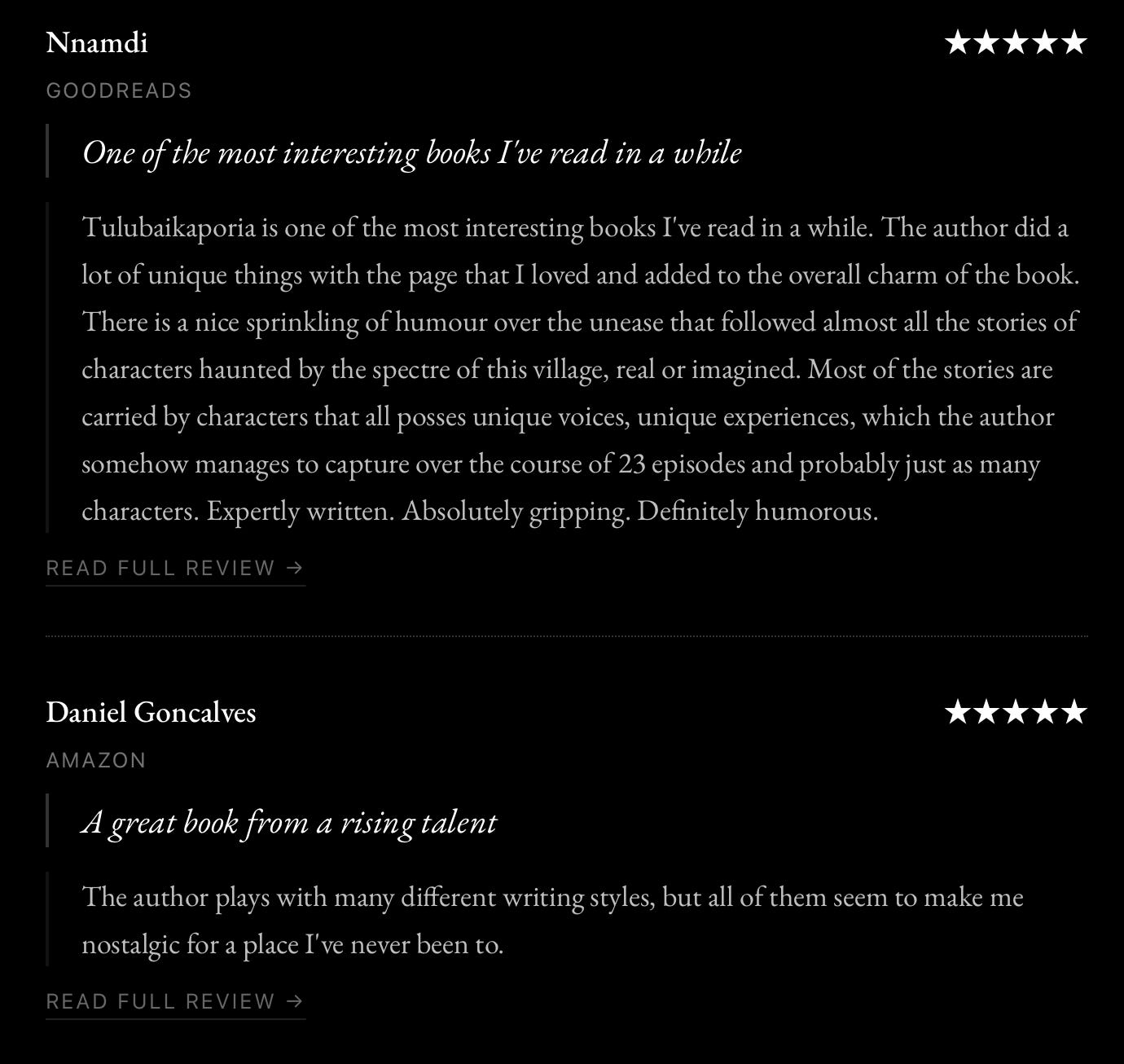
Reviews on the book have already started to pop up, which may or may not convince you to pick up a copy too (they should though):
Read this post for free on nova-nevedoma.com · Download PDF
OPHELIA: What means this, my lord?
HAMLET: Marry, this is miching mallecho; it means mischief.
OPHELIA: Belike this show imports the argument of the play.
—“Hamlet” by William Shakespeare
A dream’s a rogue, a phantom, a goal’s beyond our grasp; the throwback’s doomed — the past is a chimera, a monster caged and clasped.
*Boom!*
Rockets the cork with a thunderous roar and punches a hole in a white panel of suspended ceiling. And there’d been a kitty hiding. Squealing, he darts and dashes around in primordial panic until one of the panels beneath him caves in and the kitty flies right onto our kitchen table, muzzle and front paws plunging into an immeasurable pot of borscht, the immensity of which could have solved planetary hunger almost forever. We laugh, pick up the borschted Meowbius and carry him to the bathroom for a wash whilst he licks the soup off his muzzle. If he’d pulled such a stunt in my parents’ house, they’d have grabbed him by the tail and carried him to the vet whilst he mewled, scratched, begged and tried to convince them of his innocence, that he was just doing his job, just catching the universal Mouse above that ceiling as he was destined to, or even exaggerated and said that there were swarms of them, those little grey parasites, who at night drum on the ceiling with hundreds of their little paws and don’t let his esteemed and dear owners sleep. My parents wouldn’t listen, would still bring him to the vet and, holding him by the tail, get him castrated on the spot so he wouldn’t be so rowdy any more. A castrated village cat as a metaphor: lazy, fat, with eyes either like those of an Alexandrian philosopher or a Tibetan monk, having convinced himself of the superiority of mind over phallus, living his best life where he needn’t kowtow to his libido, but can simply eat, sleep, meditate on dancing flies, sunbeams, and sparrows. But a metaphor for what? Ponder later.
— And you… when was the last time you were in Tulubaika?
Slavoslav Slavoslavovich1 is now a balding, paunchy copper. His blue eyes have turned navy to match his uniform, his golden mop got tired of sitting on his head and sprawled all over his body. I want to have a proper chat with him, but there’s nothing to talk about. Not because he’s bald and paunchy, and not even because he’s a copper (though such treachery, I must admit, is hard to forgive, even harder not to joke about, and impossible to weed out of your head), but simply because too many chaotic moments have occurred between the past and present, which, as in an old black-and-white cartoon, magically lined up into a huge interpersonal wall, propped up on both sides by rusty cast-iron pillars. “We don’t need no education, we don’t need no thought control.” We live in different strata of reality. I’ve been to Berlin and seen the wall, and he hasn’t, which is a shame. He probably can’t even leave the country, which is also a shame. We speak different languages whilst using the same words and grammar. Life is morphology, a birdly fall into the ocean, but not for fish. To die? Oh no, to reach the depths. What depths? The depths of understanding existence through the study of forms. For there, in the darkness deep, down at the bottom, is a window, and in that window — transcendental visions, perhaps a fat learned cat2, waving its paw at sparrows, lies. No longer walks he round the golden chain, instead, turns over a chimera-thought in his lil’head, ponders how young he used to be, how he leapt among tall grass all dewed. Hop-skip, hop-skip — to the call of rustling wraps, pantherly homewards I bounce, mug cobwebbed — quick-quick-quick — for dry cat food shan’t wait for my arrival, shan’t ever eat itself! For who am I if not the most dangerous animal on this planet, a violent creature filled with hateful thoughts and a lust for blood and empty boxes?
What to say?
— Can’t remember. Ages ago, I reckon. And you?
We’re calculating the distance to a place that barely exists. It’s sort of there but sort of not and quantum mechanics has nought to do with it. Now, let’s take a ruler. A trophy Opel Kapitän sets off from point A to point B, but halfway to point B the engine coughs tubercularly and the car stops. The driver gets out, fixes it, continues the journey, but after travelling half of the remaining half, the car stops again, and so on, half after half. The task: knowing the speed, distance, repair time, and everything else (see Appendix), calculate when the trophy Opel Kapitän will reach point B.
— Every year I plan to but never quite manage it, — Slavoslav Slavoslavovich replies, shrugging. — Work…
— And how is it there these days, do you know?
— Oh, they say it’s good…
— That’s good that it’s good.
— Yeah… Good is always not bad… Much rain these days, they say.
— Well, there’ll be mushrooms then.
— There will be… For sure…
— I could do with frying some chanterelles right now.
— Or pickling them… Or going fishing…
— Naaay. I don’t like fishing.
— You used to like fishing.
Oh, I used to like all sorts of things, Slavoslav Slavoslavovich. I wouldn’t even pick mushrooms myself now — I’d buy them from an old lady on the road to support the local gross product per capita, because you can’t order that sort of thing on any internets.
Slavoslav Slavoslavovich finishes wiping the bottle with a towel decorated with firebirds. The birds absorb the bubbles of cava and fly off tipsy to winter in Tahiti. Whoosh! And they’re gone. There they hustle, stay and live, have children, and never return either to Tulubaika or to the surrounding villages.
— I still go… Both winter and summer… Mm… — continues Slavoslav after a long pause.
— Where to?
— Fishing, of course…
— Ah, fishing.
— Yeah, there’s a lil’lake not far from here… Not quite Tulubaikan but still decent… We could go, you know… I caught an ide recently, — Slavoslav Slavoslavovich hints modestly.
— A big one?
Slavoslav Slavoslavovich smirks, as if I’d doubted his fishing abilities, and in the air, in addition to the alcoholic fumes, there now hangs a sensation of the unstarted tale about the ide, the tale that no one will ever begin or finish, but nevertheless the tale that lingers, begging with all its being to be let out, and we, mere mortals, don’t let it, for we don’t need it — we already know what kind of tale it is, for tales like these can be told with just one look, so much so that Tolstoy himself would grow thin3, our dear Leo Nikolaevich, may he rest in peace and no war. Our dialogue with Slavoslav Slavoslavovich is built exclusively on such tales. They are the pillars of creation of the universe of our communication, unshakable strongholds, understood with just a brief stoic nod, man to man.
— You bet! Bloody enormous. Wanna see the video?
Some tales express their essence through a phone screen, just as stoically, phone to phone.
Go on then, I think to myself, I’d like to see this ide, and Slavoslav Slavoslavovich immediately draws his phone from its sheath and shows me the video of that ide thrashing about on the grass in hysteric waterlessness. Bloody enormous, indeed.
— You speak true, Slavoslav Slavoslavovich, such a biggie.
He nods and starts the video again.
— Thought the line wouldn’t hold, but luckily we managed. Had to call a lorry, though. The whole village ate that ide afterwards.
— Ukha4?
— Nay, tiddlers would be enough for ukha… Smoked.
The smoky flavour on my tongue, a whiff of smoke in my nose, and my mouth’s turning into a saliva reservoir. I watch the ide flap its tail to and fro, bouncing, and think: I’d like to give this a proper like, man to man, I must, so I scan for the heart icon, find it at the bottom of the screen, and immediately tap it. Slavoslav Slavoslavovich nods approvingly.
— I feel sorry for it, — I say, — the king of the lake waters.
— Sorry not sorry, but what can you do? It’s nature. A cat wouldn’t feel sorry for it.
— Well, we’re no cats, you and I, we’re hoomans, oh-ho-ho and what kind.
— We’re worse. A cat’s at least honest in its intentions. A cat’s an unprincipled hunter. To it, a mouse, an ide, or borscht — it’s all the same, all prey. But we… Eh…
I try to absorb the philosophical substrate and rummage through my lexicon in search of a good word to form a response, shaking my head for a long time, vibing to the music playing from the next room. According to ancient beliefs, our parents listened to this music, and now we listen to it, too. What was cringe has become nostalghia, and so it is with everything. There, behind the wall, are endless ghostly laughter and voices of several more classmates, all mixed into one voice babbling something in an incomprehensible language, even more incomprehensible than the one Slavoslav Slavoslavovich speaks. Let them sit there, behind the wall; we’re fine here. The kitchen is the temple of any party; the kitchen is where truth flows. Had I my will afree — a human will with a speck of divinity — I’d transform with one wave of my hand all gatherings, parties, events, the whole world into a small table pushed against the wall in the kitchen with three chairs around it and people casually consulting each other about crises of various grades: existential, spiritual, creative, financial, political, ecological, even approaching midlife ones. Thus we’d sit in the wafting wisps of a wakened, wined wonder and talk, talk about this and that, about everything, about bits and bobs, the infinite and finite, in particular about how to achieve harmony of cosmos and chaos in the process of cooking borscht, and why borscht might be the key to understanding dialectical materialism and metaphysics as a whole. Real borscht, like real life, isn’t cooked by the book, but by intuition, by eye and by avos’5, and the correct dialectic occurs to you only when your head cracks along the welding seams in the morning. The main thing is to remember that in a true dialectical borscht there’s always room for thesis, antithesis, and synthesis, and, of course, smetana6. Where would we be without it? For smetana is the symbol of unity and struggle of opposites, Gogol once said to Hegel. Only in such a kitchen confessional, in this cabal of souls desperate and splattered with borscht, can something real, something alive be born.
Here Alephtina finally returns, alone and without Meowbius, looks at us, at the ceiling, at the pot, shakes her head, sighs.
— Please eat the borscht.
— With the cat? — I ask.
— What do you mean “with the cat”? Should we throw it out now?
— Well, there’s no need to throw the cat out… — Slavoslav Slavoslavovich smirks.
— Our cat’s clean, we wash him every week.
— And he licks his cat balls every day.
— He’s got nothing to lick, don’t worry.
— He licks anyway, though. Thoroughly, with hope. One never knows; they might come back.
— He probably doesn’t even know they’re gone. That’s how you live your life, with balls, and then — bam! — no balls, but the habit remains, — adds Slavoslav Slavoslavovich.
— Yes, they both exist and don’t exist until he looks “down there”. This sort of thing often happens with cats, — Alephtina giggles.
As a child, Alephtina read Borges and thought that “Aleph” was about her. With age, however, she understood that it was, is, and will be about Tulubaika. At the moment when this Truth revealed her sacred orchid before Alephtina, she decided to abandon her previous endeavours and become a scientist. Now Alephtina is an asymptotologistess, application-oriented, studying ley asymptotes, a special type of ley lines (world-connecting curves) which one can approach indefinitely without ever reaching them. In Tulubaika, according to widespread theories, there is a place where these lines intersect at one point, thus forming the most unreachable point on the planet.
— For a function f(x), the line y = g(x) is an asymptote if lim[x→∞] |f(x) - g(x)| = 0, — Alephtina explains, while I ladle borscht into bowls, and Slavoslav Slavoslavovich dilutes our cava with artisanal samogón7 of mysterious potency, distilled using an ancient Tulubaikan recipe left to us, they say, by the Mongols themselves. — In the case of Tulubaika, however, we’re dealing with a multidimensional space, where each dimension represents a separate aspect of reality. Imagine a function T(x₁, x₂, …, xₙ), where n tends to infinity. Tulubaika might be a point containing all points of the universe, a kind of singularity in this multidimensional space.
Alephtina takes a deep breath and continues:
— In mathematical terms, this is a place where the function of being T(x) doesn’t just tend to infinity, but undergoes a discontinuity of the second kind. In other words, lim[x→Tulubaika⁺] T(x) ≠ lim[x→Tulubaika⁻] T(x), and both these limits can be equal to infinity, but with different signs. Just imagine!
Slavoslav Slavoslavovich grunts into his moustache, which he doesn’t have and never has had, and pours more samogón into the cava.
— Moreover, — Alephtina continues, helically stirring the borscht in her bowl, — if we consider Tulubaika as an attractor in the dynamic system of our reality, we’ll see that it possesses a fractal dimension. It isn’t an integer, which explains the impossibility of fully comprehending it. Formally, this can be expressed as: D = lim[ε→0] (log N(ε) / log(1/ε)), where N(ε) is the number of n-dimensional cubes with side ε needed to cover Tulubaika, and in practice, — she adds, sipping her borscht, — this means that the closer we try to get to the essence of Tulubaika, the more details we discover, and this process is endless. As Poincaré said, “Science is a continuous approximation to Truth. It’s an eternal chase, but not after a chimera, rather after an asymptote”.
— White noise… — Slavoslav Slavoslavovich mumbles.
— They don’t teach you this in cop school?
— No, they don’t, and for that thanks to our comrade Major Yehoshua, may his memory be blessed, — he adds sarcastically. — No need to dilute our Orthodox thought with your foreign sciences. For such heresy, we could lock you up for fifteen days8, citizenette9.
We all laugh heartily. Alephtina leaves her spoon in the bowl and eyes the glasses, clapping her hands in anticipation.
— Tell me, what have you concocted?
— So, mademoiselle, we wished-s10 to concoct a refined from-over-yonder cocktail, following a most esteemed French recipe. Alas, upon inspection, we discovered-s that our Champagne is from Spain, and the English gin is nowhere to be found. Therefore, if it pleases you, we shall substitute-s it with the Tulubaikan samogón traditionnel, forsooth.
— Oh indeed, messieurs, that is how great discoveries are born, isn’t it? — says Alephtina and picks up her glass.
— Well… shall we? — says Slavoslav Slavoslavovich.
— We shall, indeed.
We raise our glasses and clink them.
— Wait-wait, what about helixing?
— Right you are, mademoiselle.
— Not for nothing you’re a scientist now, citizenette.
We swirl our faceted Soviet glasses until little whirlpools form, following Alephtina’s advice to create a stochastic process in the drink and enrich it with oxygen. We sip. The spirit rushes through the body in spirals, warming the corporeal and the incorporeal. My chronic déjà vu immediately intensifies, and my forehead fills with a hot-cold sensation that we’re sitting exactly as we sat ten and twenty years ago, and everything around is nothing but a nostalgic dream staged by a radical art-house theatre troupe—
— One every day, — says my doctor, his fake clownish moustache turning him into Felix Dzerzhinsky11. — Best in the arse cheek. Right or left — you pick. But I stick it in the left — I fancy commies, you know. Go on, give it a go.
In my hand — a syringe, pearlescent goo shimmering inside it. As if I’m about to jab myself with a vial of glitter.
— And then boom, it’s all gone?
— No booms, compadre. It’ll be gone gradually.
— Maybe there are pills?
— The pills are bitter as olives from the tree. You might get asphyxia (and not an erotic one, mind you). Then, of course, everything’ll be gone with a boom.
— Is there perhaps a stronger dose? Like, one-and-done, fixed for good?
— No, compadre patient, be patient. Chronic déjà vu is incurable, I’m afraid. You’ll be on jabs for life now. I suffer from it myself but I jab it regularly and it’s fine — no bother. But if you ever want it like before (ha-ha), skip a couple of days and everything will be back to square one. Will you give it a go now?
— My wife will “give it a go” for me at home. I’m afraid to do it myself.
— I could “give it a go” for you.
— I’m fine, thank you very much.
The doc nods understandingly.
— Better before dinner, this one.
I stand up, adjust my shirt with rolled-up sleeves, shake the doctor’s poisonously blue rubber hand, and head for the door.
— Doc, what about the centrists? — I ask before fleeing this torture chamber.
— Ah, those… They use rectal suppositories, so it dissolves inside. It’s uncomfortable to sit at first, though. The suppositories aren’t small, mind you.
We nod to each other stoically, man to man. I exit, slamming the door—
On trips, I give it a go myself, contorting in front of the mirror in the hotel bathroom. I alternate right and left, just in case, to avoid jinxing it, but I reckon I forgot to dose up today and yesterday. So here we are, flare-up time.
— Oh, how lovely! — Alephtina exclaims, polishing off her glass. — This is what I’m getting at. How’s your car, Slavoslav Slavoslavovich?
— Well, I took a taxi here. It’s a piss-up, after all.
— What do I care about your taxis, Slavoslav Slavoslavovich? The Opel, I’m asking about your trophy Opel.
— Ah, the Opel… It starts up.
— Does it run?
— Runs it does. Not quite factory-fresh, mind you, but goes like the clappers. Bit of a rattle here and there but that’s nought. More “authentic” that way, as they say.
— Will you give us a ride?
— Well… — Slavoslav Slavoslavovich clams up.
— For old times’ sake. When else will we get a chance to ride in a trophy Opel?
— Well… There are still a couple of parts to replace… Can’t seem to find the right paint…
— Just tell us which one you need and we’ll sort you out.
Every evening after work, and sometimes on weekends, all year round, Slavoslav Slavoslavovich escapes from his family for a rendezvous. He walks along dark streets, encountering stray dogs and the absence of asphalt on the way, but such nuances are like smetana to a cat for him; he’s a copper, with a gun. Reaching the coveted garage — one of the endless alleys of them, planted by Stalin himself back in the days of the Union of Soviet Socialist Republics — Slavoslav Slavoslavovich opens the gates. Before him, as in a fairy tale, appears a slightly rusted but clean Opel Kapitän Cabrio, coloured like Schutzstaffel uniform, full of rounded forms, equipped with bug-eyed headlights and a distinctive radiator grille, that very legendary car on which Slavoslav Slavoslavovich’s grandfather drove from Germany in nineteen forty-five, fuming home victoriously to Tulubaika, minus one ear and two fingers on his right hand that were scattered around Europe. At one point, the totality of parts that had fallen into disrepair in this Opel amounted to about a hundred per cent. Slavoslav Slavoslavovich managed to replace some from local sources, some I sent him from overseas. Question: does the old grandfather’s Opel remain the same trophy Opel if every original part in it has been changed several times? One might accidentally become a Volga that way.
For a split second it darkens, either in the world or in my eyes, but immediately after that, the night illuminates the kitchen with lightning. She’s looking for sad people, the lightning. Hail begins to bombard the balcony windows and door, in a minute filling the balcony itself to the brim with icy tennis balls until they start spilling over the edge. Thunder drowns out the music, but the squeals and gasps of those gathered for the piss-up are still louder.
— That’s some weather!
— Did you clock that?
— Fuck me sideways…
— This has never happened before and here we go again!
— Blazinn oodles!
— I hope my greenhouse is still standing…
Flash number two. Scratching the linoleum on his way and bumping into every doorframe, Meowbius, electrified after a hairdryer ordeal, bursts into the kitchen and, with one precise leap onto the fridge, begins the ritual of summoning the sly one12.
— Ekekekekek tenebris princeps, audi vocem meam, surge ex abysso, miau, et appare coram me! — he could have shouted, and we all could have chorused “amen” at the end. We could do so much more that it’s unclear why we’re not doing it, at least “for the plot” it would definitely have been worth doing.
The light in the flat goes out, someone in the next room yelps, someone laughs, an unknown piece of crockery breaks.
— “Let there be light!” the handyman declared and snipped the power dead!13 — announces one of the guests.
The frightened cat’s orbs begin to glow with hellfire. Around his fur gathers a sparkling aura. Oh no… Oh no… Oh no, no, no, no, no.
— Miau! Nunc est bibendum lac! Ekekekek — Meowbius could have howled. — Audi me, serve humane! MIAU!
Here the powerless fridge under the cat could have suddenly turned on, hummed, shaken, its door could have swung open and out he’d come — the sly one himself, looking like a chort14, hairy, with polished horns and hooves. And we’d sit together with him, and knock back pure Tulubaikan samogón and chase it all down with toasted bread with demonic amounts of garlic, of which he, the sly one, wouldn’t be afraid and would have prepared it for us in the fridge converted into an oven. But no, life isn’t like that. Alas.
Alephtina wants to pick up Meowbius, but he hisses, kicks, flails his paws chaotically, so that with one careless blow, Alephtina would be walking around with an eye patch. A boozer uncle of mine in Tulubaika once had his hands so scratched up by his cat that my aunt thought he’d tried to cut his wrists, called the shrinks, who somehow packed him into a straitjacket and carted him off in a white bukhanka15 to the yellow house16. What they did to him there remains a mystery, but he returned sober and never drank again. Note: treating alcoholism with a cat.
— Leave him be… He’ll shred you to bits, — Slavoslav Slavoslavovich tells Alephtina, leaning back slightly.
— He’s got no claws, — Alephtina replies, trying to wrangle the cat.
— No balls, no claws… What a life…
— He’s just scared. Look, he’s calming down already, — she nods at Meowbius purring in her arms.
With grace, electricity returns to our chambers. To the accompaniment of copper pipes17 and the whole orchestra joining them, those gathered burst into applause, whistles and sincere thanks to Ionius, the overlord of electricity, and the master of all free ions in the universe, who, to become free, had to protest against universal darkness quite a bit.
Someone, whose seasoned face I haven’t yet recognised, quickly pops into the kitchen, asks whether we are bored sitting in the kitchen all by threeselves (cats don’t count as conversationalists, not even ones like Meowbius), offers to join everyone else, to which we unanimously no-no, offers a joint, which we also prefer to no-no (for now, though), then, shrugging us off, grabs a random bottle of alcohol and, bowing out, leaves the kitchen temple.
Alephtina goes to the fridge with the disgruntled cat, opens it with one hand, takes out milk and pours it into a bowl. Meowbius, jumping down from her arms, begins to lap up the feline holy water, smacking his lips. She, meanwhile, takes out an hourglass standing on the corner shelf under a portrait of her smiling wrinkled grandma in a headscarf. Inside the hourglass, instead of sand, is nothing other than the ashes of the said old lady, who was rumoured to have possessed extremely supernatural abilities (at least by Tulubaikan standards). Sighing heavily, Alephtina sits at the table and places the hourglass in front of us. In a thin stream, Grandma Nüra seeps from the upper part of the hourglass into the lower.
— How long does she last?
— That I haven’t figured out yet, to be honest.
— We could just flip it over, — says Slavoslav Slavoslavovich and reaches for the hourglass, to which Alephtina lightly slaps his hand.
— Hands off or I’ll flip your head over; better pour us some. You’re performing your duties poorly, Comrade Captain, — Alephtina declares sternly, yet with an indecent amount of irony, and pushes her glass to the centre of the table.
By copper’s will and Alephtina’s wish, the vessel brims with cava and samogón’s swish18. I, meanwhile, lean towards the hourglass to observe Grandma Nüra’s descent.
— Look here, — Alephtina intones, after first rinsing her mouth with the drink. — There’s very little left.
We, pretending to have understood everything, nod in unison, men to woman.
— We need to go there sharpish, — she enunciates, taking a sip.
— Where to?
— Where do you think? To Tulubaika.
— To Tulubaika?
— Oh.
— You do come out with some bangers sometimes, Alya19. “Sharpish!”
— I’ve found out that, with a margin of error of three point four per cent (dead accurate, I should mention), Tulubaika will vanish as soon as Grandma Nüra runs out.
— Vanish? — Slavoslav Slavoslavovich and I ask, taken aback.
— Vanish.
— Just up and vanish, like that?
— Precisely like that. A spacetime singularity will occur and the village will collapse into itself. Flop and gone. Well, that’s in theory.
— Well, blow me down… — Slavoslav Slavoslavovich drawls, scratching his bald bonce. — Like in the Bermuda Triangle?
— No, for real. No fairy tales. Poof! And no Tulubaika.
— How’s that?
— Just like that. You know how it was in childhood? Your grandma asks you to help. “Go fetch some bread,” so she says. You agree, toddle off to the kiosk, but it has run out of bread. What a pity, right?
— Too right.
— So you think: I’ll go to the next village then, can’t let grandma down, can I? You walk for an hour through fields, through birch groves burning with golden flames, triumphantly buy the last loaf of white bread in the only shop called “SHOP” in the neighbouring village, walk back, get bored, hunger awakens in your belly, you forget everything in a childish way…
— For a moment of total transcendence…
— Exactly. You start eating this bread, just biting the loaf straight from the bag — it doesn’t matter where you’re taking it or to whom, it’s still warm, crusty, the most delicious fresh bread you’ve ever tasted.
— Wouldn’t mind some fresh bread now, I must say…
— So you walk, head in the clouds, grasshopping, admiring nature, maybe accidentally stumbling over an asymptote (they say children can still trip over them, and some can even jump over them like a skipping rope, fancy that), and there you are; you return to the village, but grandma’s gone — she died; they took her away in an ambulance straight to the cemetery in a coffin prepared at home, cobbled together for a bottle of vodka by John the carpenter from the boards of the old collapsed Communist Party hut. What can you do? She was old, took three nostalghin pills every day and suffered from chronic déjà vu like everyone in our parts. And there you stand thinking: what now? I’ve already eaten the bread.
— Been there, done that… — Slavoslav Slavoslavovich nods. He looks like he might fall asleep any moment.
— It’ll vanish completely. It will for us, and we will for it. If we arrive too late, we will not even recognise each other, — says Alephtina.
Time in Tulubaika always dabbled in certain dilations, like on that planet in “Interstellar.” You seem to have already graduated from university, gotten married, travelled the world, changed a dozen jobs, gained muscle and intellect — practically ascended to Apollo and Dionysus in one person, but in Tulubaika it’s as if nothing has changed, yet everything is completely different.
— That’s why I don’t want to go and won’t go, — I tell them straight.
They, Alephtina and Slavoslav Slavoslavovich, suddenly turn to me, having sheathed all their alcoholic intoxication, and ask in unison:
— And why’s that then?
And I look at them and don’t recognise them, as if my chronic déjà vu has again metastasised into chronic jamais vu. Déjà vu, jamais vu… Even a sober tongue would tie itself in knots, not to be untied. The world’s a splash from fish tails gliding through void’s vast sea. Splash! And chimeras flee the present, troika-harnessed20, clasping throats of forms and images, devouring all they see. Memories entwine in wreaths, from mind flee silently, sprawl languidly on graves. These people I (don’t) remember, their faces (un)familiar to me, their voices (not) known to me, a ghostly similarity is all my wretched thought can find, reflected in their plea — eyes hungry for my words, awaiting eagerly.
Somewhere in the beautiful distance, lightning flashes, and the sound of rain and thunder gently-nostalgically taps on the membranes of our ear shells. I sit, watch, unwind a thoughtful thought — the answer won’t construct itself, just like communism over and over again, while in the next room the lads get out a guitar and start singing Yegor Letov21:
Distant Ophelia laughed in her sleep:
A pot-bellied thrush, a shaggy deer
The habitually last year’s painted snow
Easily, lightly and cheerfully crunches on teeth.
— Jamais vu, — I finally answer after a pause as long as two pauses (or three).
— Jamais what?
— Huh?
— Jamais vu. Like déjà vu, but the opposite. You look around and everything seems like it’s for the first time. I’m afraid that I’ll arrive in Tulubaika like this and… What will I see there? Neither grandmother’s baking, nor fishing with grandfather, nor the cat Dulcinea engaging in mouse-catching and obscurantism, only the creaking junk in the form of a windmill that echoes throughout the area, trees grown to the skies and fields overgrown with shrubs and weeds. Jamais vu, in a word.
— Complete jamais vu, comrade…
— A function discontinuity… — Alephtina mutters and winces from an apparent attack of her mathematical synaesthesia.
— Flush it down, — says Slavoslav Slavoslavovich and gives her his freshly prepared portion of Tsar Cannon22 (thus we call our concoction).
The theatricality of the musical performance in the neighbouring room intensifies manifold and begins to sound from inside my skull:
Enamoured Ophelia drifted far away
The night was bright, the earth did ring
Hastily hurried, without hiding from view
The clock to its foolish, comical land
Obedient Ophelia floated to the east
A wondrous captivity, granitic delight
A lemony pathway to an orange grove
Invisible lift to a transcendent floor
— So what’s the point of going then?
Alephtina rolls her eyes.
— All the more reason. That’s the whole point. We need to go.
— I don’t want to go anywhere.
— Consider Tulubaika as a quantum system T(ψ). If we can describe the attempt to return with the equation T’(ψ’) = M[T(ψ)], where M is the measurement operator changing the state of the system.
— White noise…
— Returning to Tulubaika is equivalent to finding a fixed point T(ψ) = M[T(ψ)], but the existence of such a point is not guaranteed, because Tulubaika is not only a point in space, but also a continuum of states described by the statistical ensemble of our memories and expectations.
— I second that, — I say, then nod towards Slavoslav Slavoslavovich. — But the noise is still too white.
— In short, the past Tulubaika is asymptotically unreachable by definition. Consider it gone already… (Alephtina hiccups) And it won’t be back. But some version of it still exists…
We sit, silent, hiccupping, in one ear — a guitar, in the other — Meowbius’s purring, sprawled on the floor by my right foot, the very one with a hole in the sock, causing the big toe to stick out and provoke the cat to bite. Ekekek he goes, ekekek. The borscht has already cooled; in it, the smetana has spread in white lumps, cosily gathered around oval drops of yellow fat that now tends towards a solid state. Meanwhile:
Distant Ophelia laughed in her dreams:
A weary demon, a willow bush
Gifted ponies scattered at dawn
To the four winds — try to catch them now—
— You see, compadre, chronic déjà vu, — the doctor tells me, — is not just an obsessive feeling but a whole syndrome of temporal dysfunction. If left untreated, there occurs, so to speak, an inversion of the perceptual continuum.
— Huh? — I exclaim.
My brain is about to melt and flow out of my ears.
The doctor exhales all the air from his lungs and, gesticulating like a juggler, continues to broadcast his cerebral ambrosia:
— Imagine the brain as a huge hourglass where the grains of sand are your memories. With déjà vu, this hourglass works as it should but with a small glitch when sand from the lower bulb, by a miraculous coincidence, seeps back into the upper one. But if no measure is taken, it can get worse, and the sand will start to get stuck. First in the narrow neck, then in the bulbs themselves.
— I see…
— By looking at you, I don’t think you do. The danger is: when a critical mass of memory-grains gets stuck, your brain is no longer able to make sense of this petrified chaos of memory, and begins to perceive everything as new, even though you remember everything. This is jamais vu. You look at your wife and feel like you don’t recognise her. You come to your home village and feel like you’re seeing it for the first time. You read a book you knew by heart, and each page is again a revelation to you. But the worst thing, compadre, is that you stop recognising yourself.
The doctor falls silent, thoughtfully stroking his fake luxuriant moustache. Quite dramatic, that chap.
— Even suppositories won’t help there. Regardless of their size.
Biting my lower lip, I nod and once again shake the doctor’s poisonously blue rubber hand—
In the dewy morning, after the roosters hoarsely greet the dawn, we (plus grumpy Meowbius), sobered up, slightly gloomy, charged with ibuprofen, nostalghin and melancholin, will sit in the trophy Opel Kapitän and, puffing and rattling, collecting potholes and chort-knows-whats, across the boundless field between oat dunes, in the shade of birches blazing with golden fire, with rotting leaves wrapped around the wheel, mixed with the rotting remains of bad news from newspapers, which you’d only use to wipe your arse with, will head Tulubaikawards.
But for now, we’re still sitting, watching gravity pull Baba Nüra’s23 ashes into the lower bulb of the hourglass, finishing off the dialectical borscht reheated in the microwave, and listening as, somehow keeping the chords and rhythm, behind the wall in which there isn’t a single brick, Pink Floyd together with Ophelia drown in the raging streams of borscht…
How I wish, how I wish you were here
Ophelia drowning in a borscht bowl, year after year
Running over the old ground, what have we found?
The same old fears, I wish you were here.
If you liked this story, you’d be happy to learn there’re 22 episodes in Tulubaikaporia, a book that’s already available for you to read in its entirety:
A name that’s a bit too Slavic. His parents desperately wanted to maximise his patriotic credentials, hence this. “Slavoslavovich” is a patronymic, meaning his father was also named Slavoslav. It’s not a middle name but rather a distinct way of formally addressing a person. The US equivalent might be “Liberty Freedom Jefferson” or “Patriot Eagle Washington,” while Brits might encounter a “Winston Britannia Churchillton.”
A fat learned cat here and later is a reference to the prologue of Pushkin’s 1820s poem “Ruslan and Ludmila” — a tale-telling cat who walks on a chain around an oak tree.
The etymology of Tolstoy’s surname (Толстой) likely stems from an adjective “tolstyj” (толстый), which in Russian means “thick”, “fat”, or “stout”.
A minimalist fish soup. Its defining feature is the pure, concentrated fish broth.
A peculiarly Russian faith in perhaps-it-will-work-out-somehow as a philosophical principle. It’s neither quite fatalism nor optimism, but rather the comfortable space between preparation and surrender where one throws caution to whatever fiasco may come.
An Eastern European version of sour cream, typically with higher fat content, thicker and more resistant to heat, making it more versatile in cooking.
From Russian “само” (self) and “гон” (distill, run) — a homemade alcohol (moonshine), the foundation of Russian village alchemy. The Soviet state periodically criminalised and tolerated the practice in alternating waves, never quite eradicating it. Neither scientific precision nor legal permission feature prominently in its production, which traditionally occurs in copper apparatuses of questionable engineering passed down through generations. Samogón’s potency fluctuates wildly on the continuum between “temporary blindness” and “ancestral visitation,” with flavour profiles ranging from “burning tire” to “aggressive pear” and much more.
A default administrative detention period in Soviet and post-Soviet Russia for minor offences and “hooliganism”. The phrase entered cultural consciousness as the standard “cooling off” period dished out by authorities for everything from public drunkenness to political dissidence.
The translator deliberately rendered “citizen” as French-infused female-gendered word, to emphasise the original tone of the message. The Russian original uses “гражданочка”, a diminutive feminine form that officials often employ when addressing women in a subtly patronising manner, combining bureaucratic formality with condescension.
The extra “-s” particle (as in “wished-s” and “discovered-s”) replicates a speech affectation from pre-revolutionary Russian. It used to be used by merchants and servants as a shortened form of “sir” (сударь/государь) but became a linguistic marker of excessive deference or affected formality. In modern contexts, applied randomly, it can be used ironically to parody a pretentious manner of speech.
CEO and founder of the Cheka (the OG KGB), nicknamed “Iron Felix”. His bronze statue outside KGB headquarters was famously toppled during the 1991 Soviet collapse, yet his organisational “legacy” has endured even after the monuments fell.
The sly one or “lukavy” is a traditional Russian euphemism for the Devil or Satan. This indirect reference reflects the folk belief that directly naming evil entities might summon them. The term appears in the Lord’s Prayer as “deliver us from the sly one” and has entered Russian cultural consciousness as a way to acknowledge dark forces without invoking them explicitly, which a cat, of course, can’t be aware of.
A famous Russian folk “rhyme” that must be recited every time the unplanned and prolonged power outage begins.
A mischievous humanoid demon or minor devil in Slavic folklore. Unlike the sly one, the chort is more of a trickster than the embodiment of ultimate evil. He can cause household mishaps, lead travellers astray, or tempt humans into foolish decisions. When Russians exclaim “K chortu!” (To the devil!), they’re invoking this folkloric spirit rather than the big sly one. The chort therefore occupies a supernatural space between serious theological threat and annoying supernatural pest.
The nickname for the iconic UAZ-452 Soviet van/minibus, derived from its distinctly loaf-like shape (”bukhanka” means “a loaf of bread” in Russian). It became the default public service vehicle during Soviet times, serving as ambulances, postal vans, and military transport. Despite its spartan interior and bumpy ride, the bukhanka has achieved cult status among both ex-Soviet and international off-road enthusiasts, some even trying to ship it to places like Mexico.
A Russian euphemism for a psychiatric hospital or asylum, deriving from the yellowish paint traditionally used on these institutions’ facades during the olden days. The phrase — colour aside — might also carry significant cultural weight beyond its literal meaning due to the Soviet practice of “punitive psychiatry”, where political dissidents were diagnosed with fabricated conditions like “sluggish schizophrenia” and institutionalised against their will.
A Russian idiom “to pass through fire, water, and copper pipes” (пройти огонь, воду и медные трубы) is all about the endurance of severe trials and hardships. The phrase’s origins are disputed: some trace the “copper pipes” to the trumpets of military glory and the test of fame; others to distillation apparatus and the survival of alcoholism, hence the translator’s decision not to render it simply as “trumpets”.
This sentence parodies the classic Russian fairy tale formula “By the pike’s command, by my desire”, which magical creatures or objects use to fulfill wishes.
A diminutive version of Alephtina (supposedly), used in an affectionate way. Alya to Alephtina is what Belle to Isabelle. Eastern Slavic cultures have an elaborate system of such diminutives that signal familiarity and emotional closeness between speakers and a range of other subtle registers.
A traditional Russian three-horse carriage team harnessed side-by-side, with the middle horse trotting while outer horses gallop.
Legendary Siberian punk rocker and poet whose band Grazhdanskaya Oborona (Civil Defence) became the voice of late-Soviet counterculture. Letov’s relationship with Yanka Dyagileva, another Siberian punk artist, inspired some of his best work, including his song “Ophelia” written after her tragic drowning death in 1991. Though he died in 2008, his uncompromising anarchical ethos and general post-Soviet punk aesthetic continue to endure.
Tsar Cannon was Moscow’s famous 16th-century bronze behemoth that never fired a shot in battle. Thus the cocktail is a twist on the classic French 75, also named after cannons, however, while the French original is based on gin and champagne, the Tsar Cannon incorporates rather stronger an unusual flavours.
Here “baba” is short for babushka, a grandmother or often an old woman in general.
I am most grateful for the footnotes; and feel sure I will learn the secrets of human suffering and overcoming from these villagers.
Wonderful! I salute thee!