



What follows are complementary materials (a couple of mini-essays + music + visuals, etc.) to the most recently published episode of TULUBAIKAPORIA:

Previous Substack instalments available here. You can also purchase the whole book — it’s already out, and readers are writing reviews!
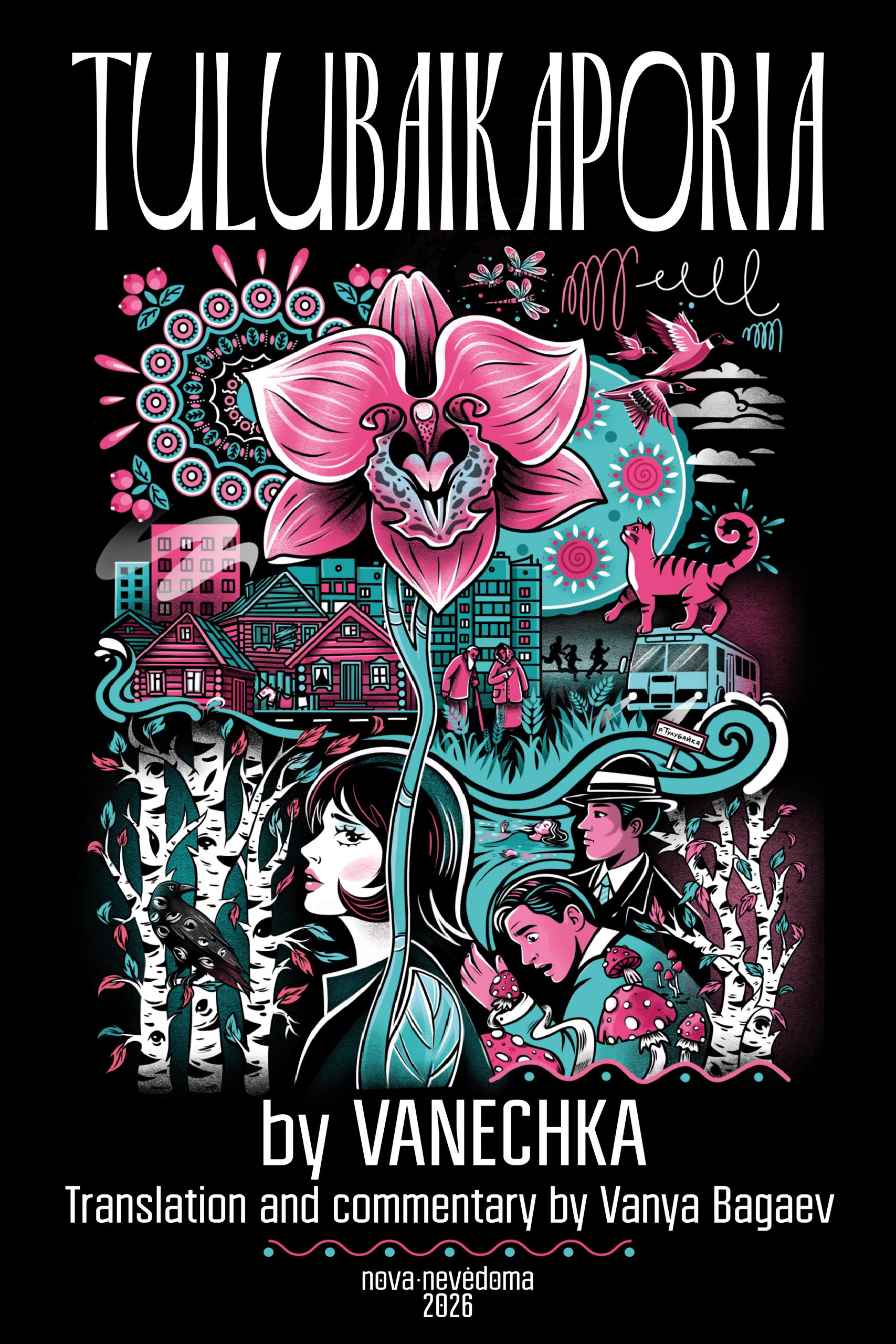
Episode 4 is an episode of dichotomies, juxtapositions, incompatible things, their impossible blends, gravitas and anti-gravitas: here and there, city and village, vertical and horizontal, darkness and light, heaven and hell, prose and poetry, Shostakovich and breakcore, and (possibly) many more. This structural motif appeared organically rather than as a result of a planned exercise — it just somehow ended up that nothing in the episode has a firm foundation or a single core as it constantly oscillates between things, exploring the metaphysical condition of not being in either of A or B (Episode 5, in that sense, is a natural continuation of this premise).
The episode was written in Russian in something inspired by Andrei Bely’s “ornamental prose” — a highly rhythmic and poetic prose, which posed significant challenges to its translation into English. Bely wrote entire novels this way (seemingly his natural voice) amongst which the most remarkable one is PETERSBURG, hundreds of pages following anapestic foot in prose, a textual and sonic masterpiece no less. Many deem the novel “untranslatable” for its phonetic qualities, many have made various attempts often following drastically different approaches and translation philosophies, both “one can translate anything” crowd and “no text is fully translatable” crowd and the rest between them.
A lot of episodes in TULUBAIKAPORIA, just like the author’s way of writing overall, are inspired by Bely, Episode 4 especially, for it is an amalgamation of a lot of literary techniques and prosaic and prosodic devices, making it, well, “untranslatable”. Our translator, Vanya Bagaev, however did his best to prove otherwise.
The extras to this episode is largely a discussion on what makes it “untranslatable” and what makes it “translatable” and what makes it “translatably untranslatable” and “untranslatably translatable”, the latter two, perhaps, even in a broader philosophical::literary sense, or, who knows, that it’s rather a flawed dichotomy!
On top of the subtly hinted answers to not-so-subtly hinted questions the reader will find a selection of the concepts and things from other media that either influenced the text directly or seeped into it inadvertently.
Nabokov lost in translation
Nothing’s more fun than arguing with the dead, so we decided to argue with Nabokov. Old Vova thought he was right at everything, which is respectful and admirable, but, despite truly being right about many things, was still wrong about quite a few. He considered the fact he had to abandon Russian and write in English his personal tragedy — something we’d rather agree on — however his choice was more pragmatic than artistic. In Nabokov’s world, mid 20th century USA, hardly continuing writing in Russian and then self-translating or getting translated was productive, hardly it was possible for him to be a writer::public-figure if he kept writing in Russian, for he had no access to Russian literary scene outside of Soviet Union simply because it didn’t exist without the likes of samizdat (self-publishing) and tamizdat (out-there-publishing), the scale of which, sadly, would hardly satisfy Nabokov’s ambition. In our times, it’s very different, an author is freer than ever to publish anything anywhere in any language — even if some “where”s aren’t accessible, there are always other “where”s. His position is, however, still relatable, for we do know, too, that self-translation is practically writing two (or maybe 1.8 books) at a time. His multilinguality from an early age made him also remarkably well positioned to choose English as his primary writing language, and hardly he suffered writing in English fluency-wise. So, for someone like us, who achieved a decent level of English only in their mid-20s, it’s only possible to comprehend a part of his tragedy, the artistic one, the whatifness, the doubt that the final work created either in Russian or English is not its best version because we picked the wrong language at the start, so for us, the choice isn’t pragmatic but purely artistic. For Nabokov it was partially true as well. We can’t get into his head but looking at his oeuvre and written accounts of his beliefs, he was a proponent and practitioner of so-called Russian-into-English untranslatability, the main point of our disagreement with him.
Untranslatability is a respectable and philosophically and philologically defensible literary stance. It can be both word-level untranslatability, in which we say that a word in other language can sometimes have no direct alternative in another language, and cultural context-level untranslatability, in which we say that some things we write about can’t be parsed by people who don’t have lived experience for it, it is, in a way, can only be felt and no explanation would suffice. Another, no less important, is form-level untranslatability, such as the way something is written, e.g. syntax, prosodic qualities, tone, register, etc. can be lost in translation so it would never live up to the original. All three stances (perhaps there are more) are legit only if we speak about a text as the main artefact that undergoes translation, that the goal is to recreate the text in another language as perfectly as possible. All of which raises the suspicion that “untranslatable” might be the wrong frame entirely.
Nabokov was pretty much the patron saint of Russian->English untranslatability. Worth mentioning tho, he probably didn’t believe in the opposite, because, for one, he translated his LOLITA himself with a straight face and, mind thee, that wasn’t the best of translations — three decades in the US can do worse than that to a man. Regarding Ru->En he was ruthless, denying translatability, as it seemed, at all levels: meaning, context, form, etc. belief that peaked at his own translation of EUGENE ONEGIN, a potentially heroic but rather doomed proposition that Pushkin in English must sound like a clinical autopsy or not be Pushkin at all, such as no rhyme and no meter, the verse flattened into a literal prose pony, and walls of text filled with exhaustive commentary, or rather a pre-emptive response to everyone who’d dare prefer something more singable.
On the word level, he had a canonical list of untranslatables, an interesting and in many ways agreeable bunch, including: poshlost’ (vulgarity-but-deeper, rather a philistine vulgarity, lack of taste vulgarity), toska (cosyish anguish, melancholic longing, often nostalgic), byt (everyday existence, routines sucking in), and istina (metaphysical, absolute truth). TULUBAIKAPORIA has footnotes for two of those: toska in Episode 15, istina in Episode 2, both — could be said — are even amongst the central concepts of the novel.
In his translation of Pushkin’s “Eugene Onegin”, Nabokov describes toska as follows:
No single word in English renders all the shades of toska. At its deepest and most painful, it is a sensation of great spiritual anguish, often without any specific cause. At less morbid levels it is a dull ache of the soul, a longing with nothing to long for, a sick pining, a vague restlessness, mental throes, yearning. In particular cases it may be the desire for somebody of something specific, nostalgia, love-sickness. At the lowest level it grades into ennui, boredom.
But of course, what doesn’t exist in English, might exist somewhere else, such as there’s the Portuguese “saudade”, the Welsh “hiraeth”, the Finnish “kaiho”, and likely others, all of which are almost perfect approximations of “toska”.
Same with istina — semantically it stands further from simply “the factual/empirical truth”, closer to “the absolute/transcendent/metaphysical truth”, the kind of truth one might find at the bottom of a well or a bottle or never at all. In the same way, German philosophy differentiates between “Richtigkeit” (correctness, factual accuracy) and “Wahrheit” in its deeper Heideggerian sense of “unconcealment” or “aletheia”; similarly, Greek distinguishes “aletheia” (disclosure, uncovering) from “doxa” (opinion); Sanskrit offers “satya” (unchangeable truth) versus “vyavahārika” (conventional truth).
So what does the book actually do with this Nabokovian translation wisdom? In reality, we could do two things: 1) concede the gap, Nabokov’s stance, the slap-a-footnote-and-move-on; Episode 4 does that once, with the Signal; 2) coin: don’t translate anything, anglicise it and let original roots grow English appendages (khondria, drebbeden, shabootnous, coffa, etc.), a move the late-Nabokov, four-volume-you-can’t-just-translate-EUGENE-ONEGIN Nabokov (hello Sir Charles Johnston) wouldn’t like, but the early-Nabokov, NIKOLAI-GOGOL-monograph Nabokov did all the time (remember his poshlust?); 3) translate the vibe, such as a translator has to recreate the affective texture from scratch: the rhythm, the syntax, the prosody, so the original voice can sing and a reader of the English text can hear it. Our main approach — after all, the texture is the meaning.
At Nova Nevédoma we believe that what’s translated isn’t the text but something behind the text, the spirit of the text, the consciousness dwelling in the text, so to say, a Platonic form of the text, not the words (literal translation) and not “the meaning” (fucking hell, what’s that even), but a transcendent “feeling” emotional / intellectual, something the text aims to create in the reader’s head, a noöspheric entity / parasite even. Hope it’s clear!
We listen and learn from Vladimir Vladimirovich, but with the figure like him the important thing is not to learn too much.
Greek, Russian & the crew
There’re a lot of Greek words (and names) in Russian and many of them, despite being foreign, already sit quite naturally in the language. They arrived in Russian in two distinct waves: religious Byzantine and later scholarly European. The first one’s via Old Church Slavonic from the 10th century onwards after Christianity was adopted taking the language into the Byzantine orbit and giving us words like katorga (originally the galley, now means gulag), anekdot (a short funny story), planida (planet, now — predetermined fate), etc. First they were used by monks, scribes, liturgy, but slowly seeped out of a religious-cultural sphere of influence to the broader vernacular. The second one’s from the 19th century onwards when Russia turned westward and imported its medicine, philosophy, and science from France and Germany, dragging tons of their words, too, in addition to Greek and Latin. Interestingly, sometimes, when Western European languages got a Latin term, e.g. arboretum, Russian got a Greek one, e.g. dendrariy, for the same thing.
In TULUBAIKAPORIA, we took the liberty not to translate many Russian-Greek words and imported them straight into English, often morphing them morphologically so they fit well. In Episode 4, Khondria is the best example. The reader might’ve seen some already in the previous episodes, and surely will see more.
“Khondria” is an anglicisation of the Russian word “khandra” (хандра), a culturally specific word to describe melancholy or spleen. The translator decided to introduce it to English as well because of the unique connotation it carries, combining elements of ennui, world-weariness, physical sickness, and a specific form of existential gloom. Etymologically, “хандра” itself derives from Greek “hypochondria” (ὑποχόνδριος), creating a lovely linguistic circle as this anglicisation reconnects with its distant cousin in English. From “khondria” we can further create “to khonder” — experience and indulge in khondria at one’s own will.
— Autumn. Weak immunity. Muck and mire. Khondria… — Stop thy khonderinn then! Everyone’s now a hypochondriac! Get thyself pumpkin latte.
The same approach of direct coinage::anglicisation is done with many other non-Greek words throughout the book, such as words of many other origins drawn from the languages of hundreds of ethnicities living/having lived in Russia. In Episode 4 alone we have: drebbeden (дребедень, nonsense, trivialities, codswallop); shabootnous (шебутной, endearingly erratic, restlessly unpredictable, someone equally charming and exhausting); coffa(кофий / кохий, old-fashioned way of saying “coffee”). Those are just examples that stand out — any active, widely used, often colonial language is always a mix that’d make any language purist squirm. In Russian — which TULUBAIKAPORIA demonstrates — you can find thousands of words of Turkic origin (Tatar, Mongol, Polovtsian), Finno-Ugric (mostly northern), of course Greek, Old South Slavic (a lot of Bulgarian, btw, early literary/liturgical Russian was kinda Bulgarian until it started stealing from the next entries in this already too long array of languages), German, Dutch, French, Italian, Polish, English too, Farsi, Arabic, Yiddish and Hebrew, Caucasian, and much more. A western reader might not realise that when they think of “Russian” but what’s hidden behind that umbrella is total ethnic, cultural, and linguistic chaos, and some harmony, too, perhaps (one can only hope). In a sense, with a big dose of evidence and speculation, Russian itself (and “Russia” broadly) is a centuries-long un-translation project.
That said, the book’s title, TULUBAIKAPORIA, is created out of three languages. In it, there’s 1) Turkic roots (tolu — “full”, “filled”, “abundant”, “complete”, “plentiful”, and bay — “rich man”, “lord”, “master”, “wealthy one”, which is hugely productive in Turkic onomastics, e.g. the same root is behind bey (Ottoman title) and bai in Central Asian usage); 2) Russian suffix -ka, a feminine diminutive suffix that miniaturises, domesticates, colloquialises anything it touches (e.g. kniga, “book” -> knizhka, “lil’book”, or well, Vanya -> Van’ka -> Van-ech-ka); 3) Greek -poria, from ἀπορία — “without passage”, “no way through”, the state of being stuck, also a philosophical term for logical impasse.
Andrei Tarkovsky’s Nostalghia
Andrei Tarkovsky also believed that some sensibilities are culturally unique, such as a form of nostalgia that is unique to Russians travelling or living abroad, which he believed was even deeper than toska, “almost a disease”:
…”an illness that drains away the strength of the soul, the capacity to work, the pleasure of living..”
And, in another breath:
…”a profound compassion that binds us not so much with our own privation, our longing, our separation, but rather with the suffering of others, a passionate empathy…”
This whole idea and his personal experience, too, he turned into a film, Nostalghia, where the protagonist, a writer, travels to Italy to do research about one Russian composer, but nostalgia aroused by homesickness starts haunting him.
The film is sedate and slow and is full of long takes, symbols and dream-like sequences. The last scene features an 8-minute-long take where Andrei Gorchakov, the protagonist, tries to carry a lit candle through a pond without letting it go out. The camera follows Gorchakov carrying the candle and goes back with him when he starts another attempt.
We’re not going to put here our interpretations of this sequence — there’s no need: Tarkovsky already explained it himself in his dialogue with Oleg Yankovsky, the actor playing Gorchakov: “If you can do that, if it really happens and you carry the candle to the end—in one shot, straight, without cinematic conjuring tricks and cut-in editing—then maybe this act will be the true meaning of my life. It will certainly be the finest shot I ever took—if you can do it, if you can endure to the end.”
After the candle scene, there’s the final shot in the film. In black and white, we see Gorchakov and a dog resting on the grass of the Abbey of San Galgano, but in contrast to this piece of Italian architecture, we see a Russian wooden house and landscape in the background. Perhaps, you can find many interpretations of that shot, too, but we think it is just a perfect, sublime depiction of nostalgia caused by homesickness and loneliness, that kind of nostalgia Tarkovsky claimed to be unique to Russians, the one he experienced himself. In this type of nostalgia, you, like both Andreis, are forever trapped in one place whereas your heart lies somewhere else. Your nostos cannot be done, for there’s no sea, no ship, your Ithaca has sunk, and you’re not even Ulysses.
Shostakovich, Quartet No. 8, breakcore flip
In my ears — Shostakovich, String Quartet No. 8, allegro molto, breakcore flip.
In my head — a bit of a do.
In my soul — the nobility of feelings ignoble.
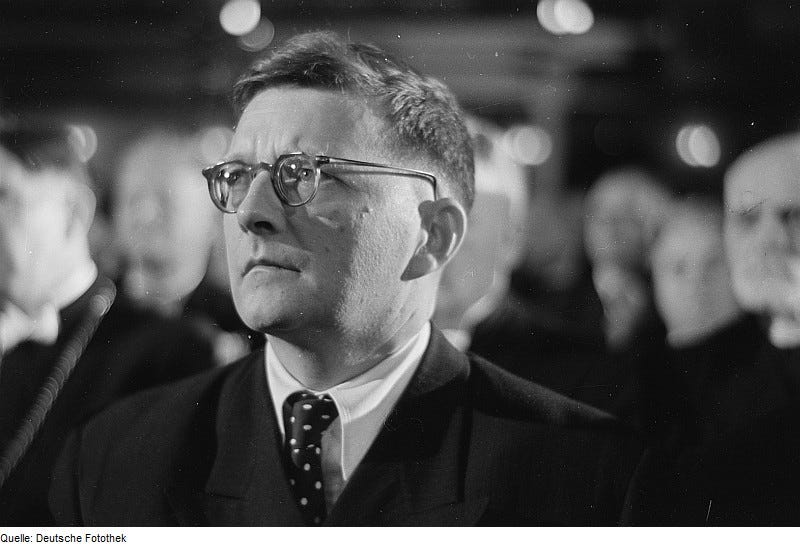
Shostakovich composed the String Quartet No. 8 in C minor, Op. 110, in just three days, 12-14 July 1960, while visiting Dresden, ostensibly to write music for a film about the Allied bombing of the city. He was rather cooked, having coercedly joined the Communist Party, which for him was a personal catastrophe and moral capitulation. He told his friend Isaak Glikman that the quartet was “a pseudo-autobiographical work” and that it was dedicated “to the memory of the composer of this quartet.”
The quartet is built entirely on the DSCH motif (Dmitry Shostakovich’s musical monogram in German notation, D-Es-C-H = D. Sch.) and quotes almost all of his major works: the First, Fifth, Eighth, and Tenth Symphonies, the Second Piano Trio, the First Cello Concerto, and the opera “Lady Macbeth of Mtsensk”. The allegro molto (second movement) is the most violent, frantic, brutally bursting piece that apparently goes so well as a breakcore.
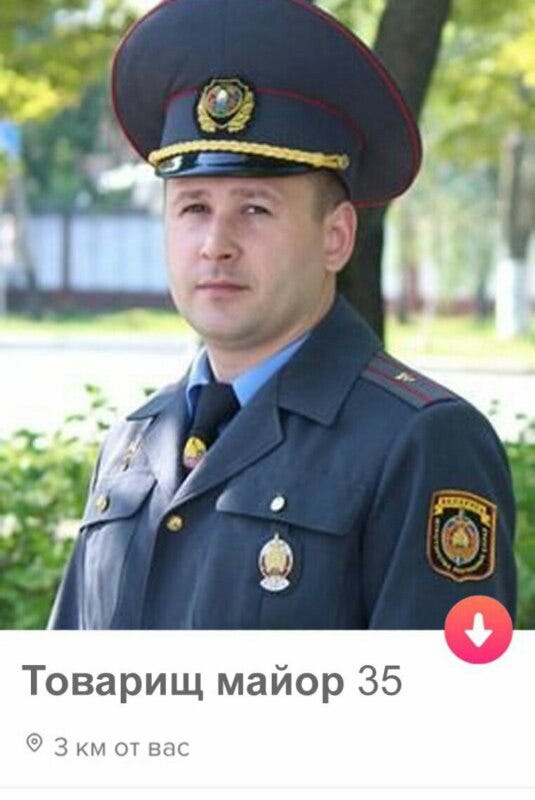
Comrade Major
Somewhere there, beneath birch crowns old and dear
a lone comrade major moonward howls his sorrow
longing for how far we’ve strayed.
O thou shalt not ask for papers no more
shalt not hit our door with thy boot
shalt not hit us with thy baton
shalt not huff and shalt not puff,
shalt not trace our IPs.
O we’re out of range, unavailable. Leave thy message on Signal, not after it.
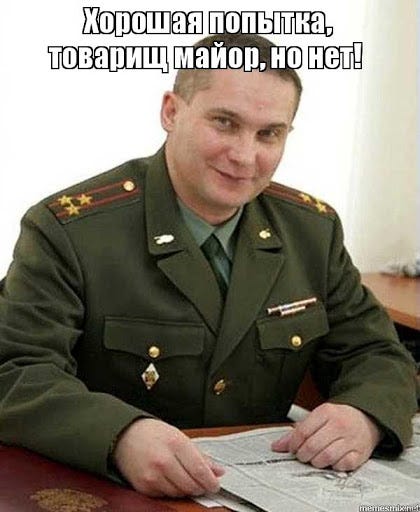
Throughout the years, the rank of “major” became memetic, coming to denote an officer of the special services or the police who pays you a visit either to conduct investigative procedures or to deal with the oppositionally-minded, creating a meme “a visit from the major at home” that has survived Soviet times and is very much alive now.
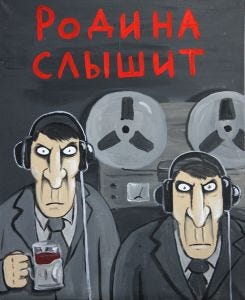
Vasily Lozhkin’s painting “Motherland knows” (with the text “Motherland hears / is listening”) is most famous incarnation of the meme. He painted it in haf an hour (as he said) as a riff on Dmitri Shostakovich’s 1950 song Родина слышит (“The Motherland Hears”, lyrics by Yevgeny Dolmatovsky), which was a Soviet patriotic anthem whose opening line Родина слышит, Родина знает (“The Motherland hears, the Motherland knows”) was already only heard ironically in the late Soviet period. Sergei Dovlatov mentioned the meme in his notebooks as “the anthem and call-sign of the KGB”, and Shostakovich himself reportedly recognised the memetic potential of his creation.
One of the most famous internet-memes on the topic, in this case evoking a military comrade major who desperately wants you to enlist or get drafted luring you into his Faustian bargain.
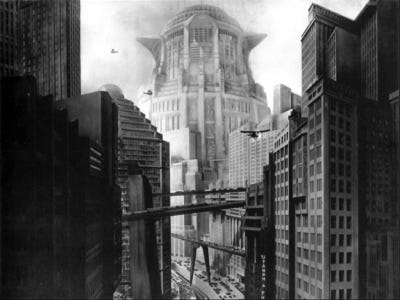
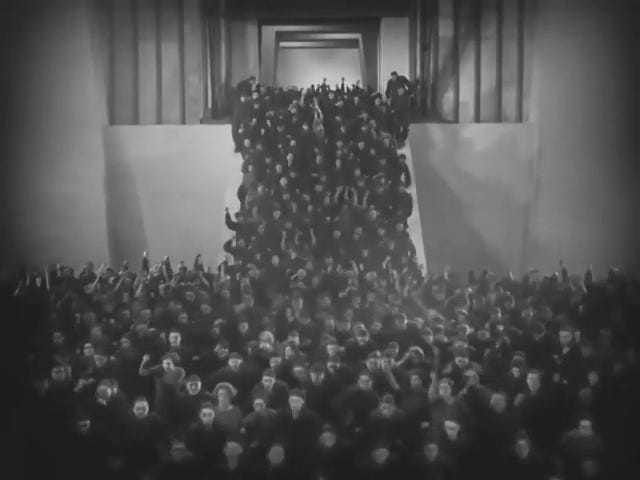
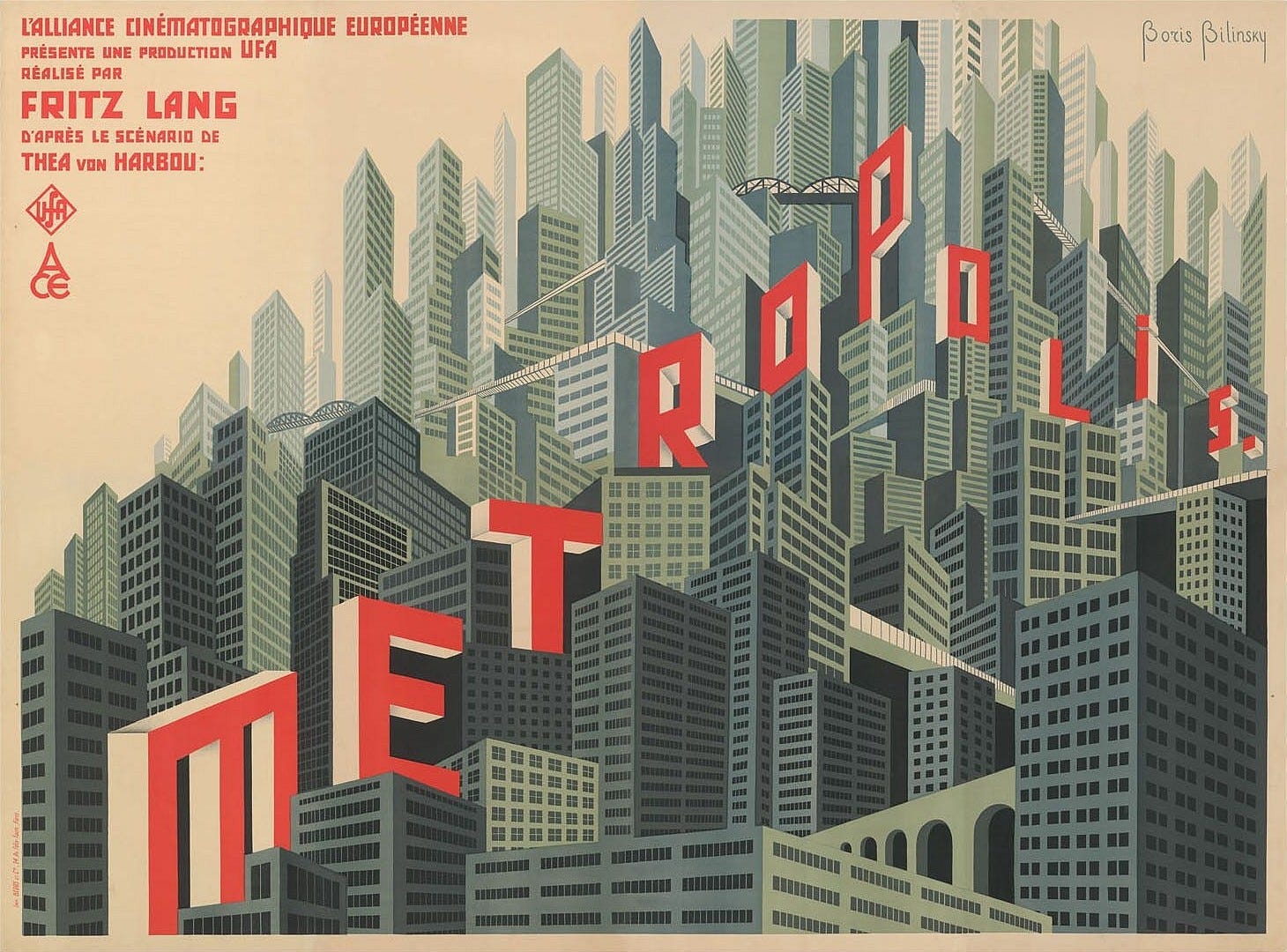
City as Element
Primordial soup of concrete, metal, and glass fills the surrounding space of this chaotically ordered universe and takes shape as walls, ceilings, floors, staircases, windows, benches, poles, stretches of tarmac.
[…]
Upwards it grows
downwards it burrows
⠀ ⠀ ⠀ as wires and pipes and metro mole-tunnels.
outwards it swells and scatters
⠀ ⠀ ⠀ to an infinity infinitely large
⠀ ⠀ ⠀ until the little human within
⠀ ⠀ ⠀ finally recognises himself as
⠀ ⠀ ⠀ ⠀ ⠀ ⠀ an infinity infinitely small.
[…]
⠀ ⠀ ⠀ — awe before civilisation’s new element:
⠀ ⠀ ⠀ ⠀ ⠀ ⠀ earth, water, air, fire, aether...
⠀ ⠀ ⠀ ⠀ ⠀ ⠀ city.
[…]
The ancients built pyramids for egoists; we raise them for thousands of souls to make birds envious, pharaohs dead jealous, and children of tomorrow marvel at our grandeur.
[…]
The city throbs, breathes, digests its tenants, and gently mocks its guests.
[…]
Soon, winds will lift human spores up in the air and disperse them around the city.
[…]
Here, underground lies half of the city, be it rail transport, car parks, or shopping malls going down and down.
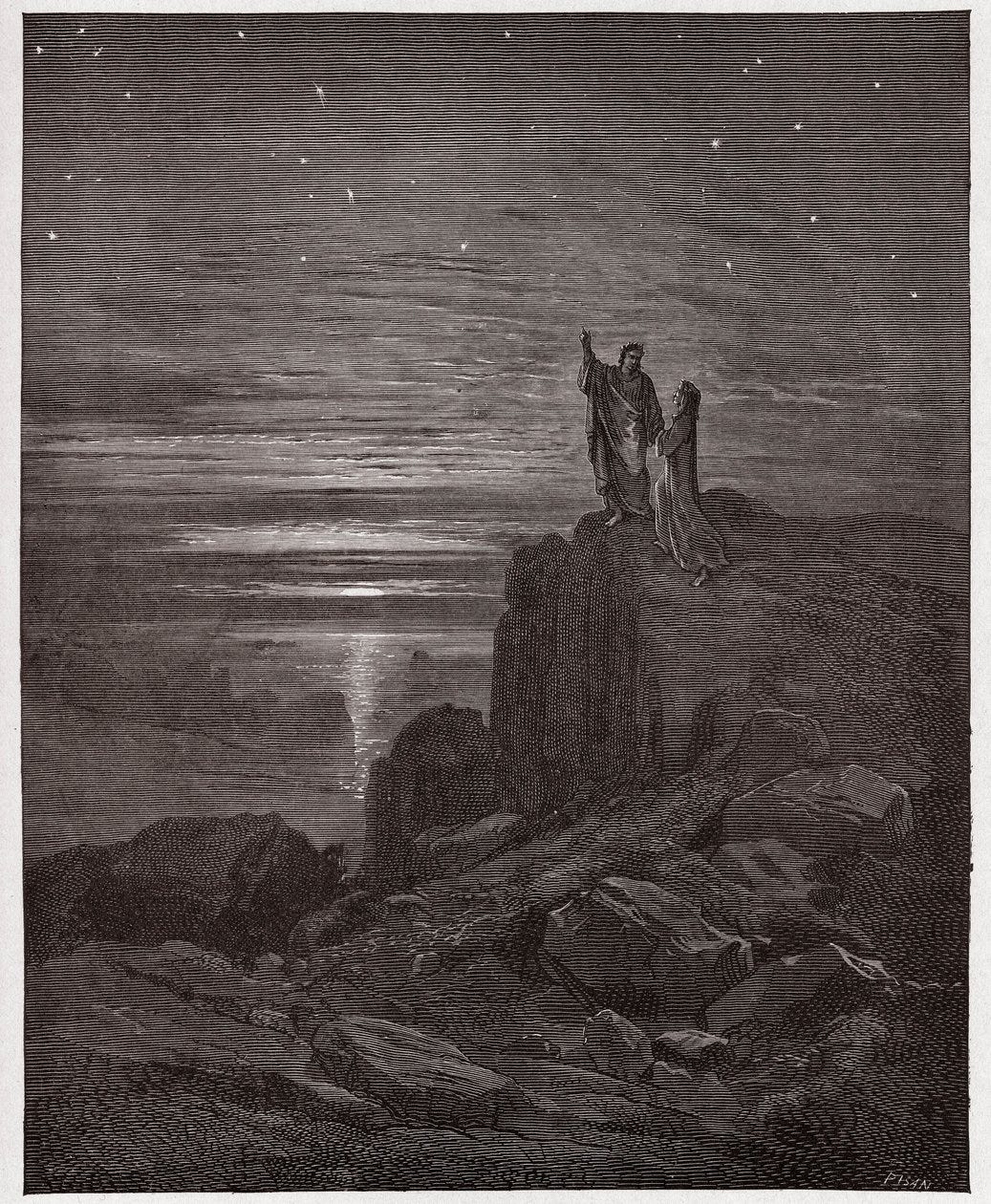
E quindi uscimmo a riveder le stelle
Joyful we leave to see the lovely things which Heaven bears
& hail the op’ning glories of the stars.
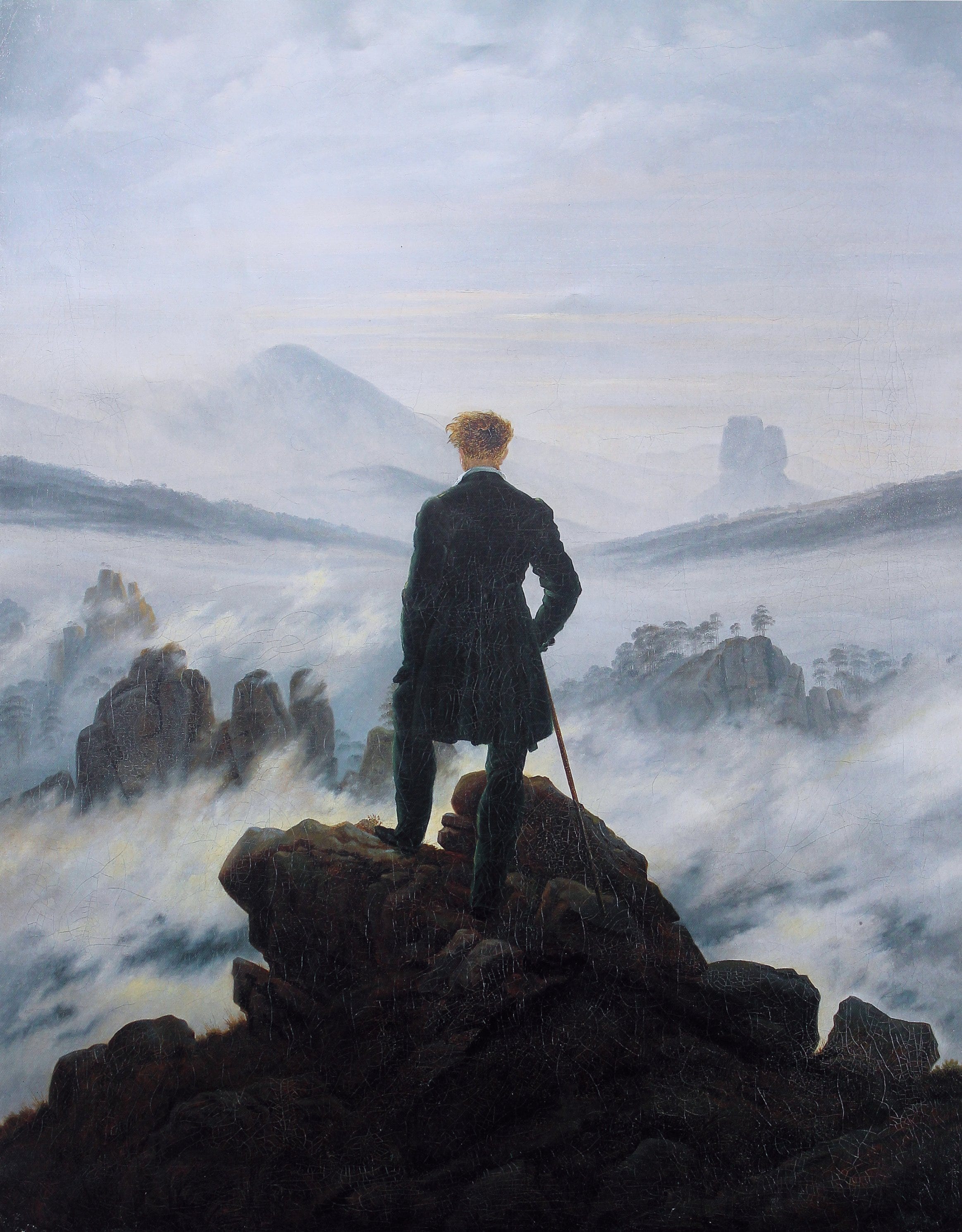
Wanderer above the Sea of Fog
& what do I see?
⠀ ⠀ ⠀ The entire world spread out!
I never knew
⠀ ⠀ ⠀ (yet I confess — expected)
⠀ ⠀ ⠀ ⠀ ⠀ ⠀ it would be only fog:
What is sticking with me, weirdly so far, is Shabootnous. So many endearingly erratic, restlessly unpredictable, charming and exhausting simultaneously people around me I can now put an idea to
I think Nabokov did an amazing job with translating "Lolita".
Speaking of which- does Vanechka think he'll ever publish his Russian original? I really love to read both orihinals and translations if I have a chance. This is one great translation Vanya Bagaev did, something to be taken as canon, in my eyes, it terms of "how the hell one does it at all".
It'd be a pure joy to read both, I suspect- granted, I already have a parallel running in my head when reading, but it's not the same.
I realize it might be impossible, technical reasons and such. Wishful thinking if you may.
Thank you for another wonderful post.
PS "Hiraeth" is a good one, I've a very bad case of hiraeth.