

Tulubaikaporia
There’s a village, but it’s vanishing as you read this


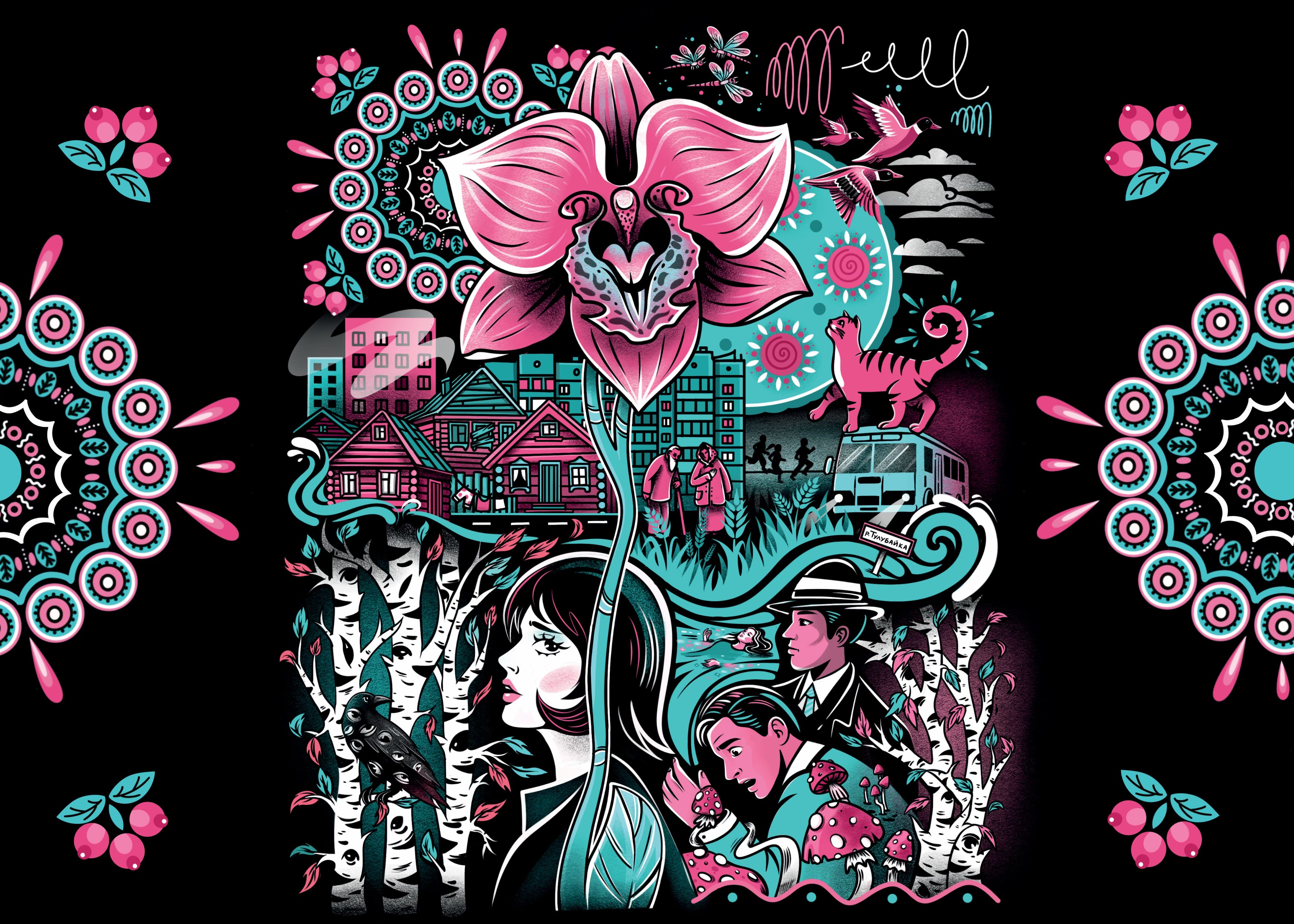
Tulubaikaporia (Too-loo-bye-kah-POR-ee-ah)
the word, is born from combining
Tulubaika, the village’s name (Too-loo-BYE-kah)
and aporia, a logical impasse.
Before we answer the most important questions, a few words from vanechka:
The book is out! Three years of work! Today’s something people call “the launch day”. Well, finally, who could’ve thought it can actually happen in the realest of the real realities. Yesterday, a gnawing anxiety was following me and I even checked if the book was indeed written and all of it wasn’t some sort of delusion, an imagination of playing a trick on me that I’m a writer who, wow ah oh, wrote a novel, a whole lot of four hundred pages of a novel, the longest, most complex, most ambitious, most virtuosic work of mine. I hope — and, well, sure — that you’ll enjoy reading Tulubaikaporia and being in Tulubaika as much as I did, and will, too, miss the village by the end of “the ritual” of tulubaikisation, entulubaikation, tulubaikification, and other kinds / sides of the same ritual.
Next week we’ll publish the first of twenty three episodes for free here but you can already read it on my website. I’m even thinking of serialising the book on a bi-weekly cadence for a year and disappearing in the bewildering wilderness of birch forests and labyrinths surrounding Tulubaika so then I could come back to millions of subscribers and trillions of lucres in book sales. Oh my, bloody hell!
Thank you, droogi, for being with me, supporting me, and reading my work! And liking all the memes I share. Beams of appreciation! The best way to support what I’m / we’re doing here on nova·nevédoma is to, of course, purchase a copy, talk about it, restack / repost everything you see about it! Then, only then, we’ll have a slight chance of saving Tulubaika from spatiotemporal dissolution.
More people are about to experience Tulubaika than have ever lived in the village since the end of seventeenth century. This is, I must admit, the most satisfying feeling in the process of writing this book and showing it to the world!


What is it about anyway?
To Our Wayward Children,
There’s a village, but it’s vanishing as you read this. To save it will require a ritual, and we need you. Your quest is of cosmic complexity: hasten thither. We shall furnish you with a theory of place-time-memory, whisper which way to wander, and, if needed, pour artisanal drinks: moonshine, mushroom tinctures, chai, and tears of various kinds. Neither map nor compass shall guide you (apologies), therefore venture forth at hazard, by hunch — trust to luck. Feel the path in your gut: through the golden birch labyrinths, the infinite fields, mirages, hallucinations, glossolalias, and [redacted]. We’re certain you won’t fail us. You’re the only hope, for everyone else has either left or not yet arrived. No pressure, though. If you can’t make it, at least please laugh at the wake.
Beams of appreciation,
Tulubaika
Tulubaika — the novel’s principal character — is first and foremost a village, but this is merely its most physical, poetically-grounded version, universally comprehensible, for everyone has their own Tulubaika, having left at some point somewhere for somewhere else, if not in space then in time. This village is now dying, vanishing, standing on the brink of total spatiotemporal collapse into absolute nowhere, silence, muteness, oblivion (mayhap already has) and the only way to save it is to transform it from a physical object into a mythological one, so that the number of people who possess a memory of Tulubaika and experience towards it even the most minimal nostalgic thought might grow, and so Tulubaika, degenerating from real reality, is — by way of various literary somersaults — reborn in the reality of literature. That is, Tulubaikaporia, in a way, is a ritual.
The quantity of these various somersaults, in other words “dimensions” of this Tulubaikan hypersphere, may surprise you, for the book is in many ways about how descriptive excess meets a deficit of specificity and then they fight, telepathically: to the question “What is Tulubaika?” each reader will answer for themselves. The novel manages to hold together a lot and will actively resist a single definition, refusing Tulubaika be clothed in a…
“genre”: they range from more traditional narratives to maximalist prose, from the epistolary to the picaresque, from fairy tale to theoretical essay, from elegy to absurdist comedy, from “village prose” to streams of consciousnesses, from a monologue single thought without punctuation to a phonetic experiment, from folkloric fantasy to metafiction, and the majority of them do not survive longer than a single episode;
“character”: among those the reader will encounter are adults and children and elderly, vagabond-shamans, village drunkards, lost philosophers, and talking cats (of course);
“mood”: the book is simultaneously hilarious, absurd, tender, melancholic, philosophical, psychological, physiological;
“medium”: prose and poetry here often merge into one;
“essence”: Tulubaika is a vanishing village in the middle of nowhere in Russia, a memory, a phantom, a theory, a hallucination, an erotic delusion, a word of glossolalia, and [REDACTED].
And somewhere between all this diversity of dimensions, by our design, lies the personal answer to the universal question: “What the fuck actually is this Tulubaika of yours?”
Looking at all this, one might call Tulubaikaporia as a novel an “experiment.” One might, of course, but one needn’t, for it is an experiment only methodologically, not in essence, and not by design but in outcome — it simply turned out that after twenty-three attempts to understand and describe Tulubaika, this sort of kaleidoscopic thing crawled out of the writerly womb. This is an experiment not for experiment’s sake, not with the aim of creating something complex, incomprehensible, monumental, but with the aim of finding, discovering, and feeling out new capacities for literature to contain within itself and articulate unarticulatable: complex emotions and types of consciousness, metaphysical and psychological concepts which cannot be described in one way alone, but only attempted through a dozen-odd of the most varied, striving to resolve the dramatic tension by a lovely union of form and substance — of formal complexity and emotional sincerity, of brain and heart — the union we so dearly love. In many ways this also reflects our personal philosophy: that absolute Truth does, of course, exist, naturally she does, flaunting her curves in the corridor of mirrors or the theatre of shadows, but to reach her and possess her is impossible, as is claiming otherwise, which does not mean, however, that one shouldn’t try. Quite the contrary.
Where to buy?
Ways to purchase the book
and order your signed copy or a special edition
The book’s available across a variety of online retailers and likely can be ordered via your library. There’re plenty of convenient options of all kinds, we don’t mind where you buy the book!
At this point, we don’t think about “how to get the best royalties”, and the ultimate goal for us is you having (and reading) your copy, but if you want to show your extra support, the best way is to restack this post, talk about Tulubaikaporia with your friends / family / followers, write reviews, in short, make the word of mouth work.
Moreover, if you’re on a rather less fortunate side of the capitalism spectrum, do reach out personally, we insist, and we’ll figure something out to get you a copy.
Reply to this email in your inbox
or write to this one below:
vanya [at] nova-nevedoma [dot] com
or send a chat message on Substack:
Signed copies & special editions
Should you fancy a print copy signed by the author and the translator (both, imagine having actually two autographs and not just one wouldn’t that be fabulous almost nobody can offer that we’re offering best autographs at nova·nevédoma), there’s an easy way to do so. You can choose paperback, hardcover, or a much fancy limited special edition with colourful illustrations, endpapers, and better paper quality.
Those who order signed copies will also receive various paraphernalia in a form of merchandise, such as bookmarks, postcards, stickers, the content of which we’d prefer to leave in secret / intriguing / charged with surprise / ticking that pathological curiosity of the reader.
If you don’t like filling forms, but want a personalised copy, do reach out as well.
Acknowledgements
The author wants to thank:
his dear wife Katya for all kinds of support and encouragements through the torturous process of writing and finishing this book;
his brother Ilya, for bouncing ideas about our Tulubaika, and his friends — Jeanne S , who read all versions of the book too many times, Annie Hendrix , for the invaluable feedback on the proesia episodes, and Konstantin Asimonov , for reading the early drafts;
his readers around the globe for being with him on his journey in this attention economy;⠀
The translator and the publisher join the author and thank:
artists for their lovely work — Lera Ush for the book cover, Irinka Kalinka for the original illustrations;
nova·nevédoma’s dear patrons — those who weren’t mentioned above — those who supported the press and its endeavours: Trilety Wade , Thomas J Bevan, Chen Rafaeli , Symon, Bru-Bru, Cate, S.B., Natasha, E. T., Joe H, Joe S, and Joel;
and everyone else who either directly or indirectly helped to make this book real, perhaps too real.
From Tulubaika with love,
nova·nevédoma
I have read this ritual many times. It is a masterwork.
So happy for you, proud of you, and excited to enter my very own Tulubaika ❤️❤️❤️