


“…“go to the right” is just as good as “go to the left,” because both of these directions, in terms of our desires, point to the most distant place, the place farthest away from here...”
— “The World Goes On” by László Krasznahorkai
Such a predicament, seemingly hopeless: somewhere in the back of beyond1, night eternal, darkness unending, holodrigue2 so fierce you could put engines on your chattering teeth and fly into space, rattling through its distant reaches, as they say. Snowfalling, too, thickly, persistently, not only can you not see ahead but behind as well — count to two and you’re lost. Your legs plunge knee-deep into snow; your footprints are covered as soon as you take a step. Snowdrifts keep growing and growing, growing and growing, growing and growing — so much that before you know it, you’ll start wandering amidst the fir tops instead of their trunks, and if such a thing happens, bojeupasi3, and you go dizzy, there’ll be nothing to grab onto, you’ll topple over and freeze dead into the earth. So, through all this wintry resplendence, two fellows trudged, knowing nothing of each other, unsuspecting, in complete unawareness, each in his own adventure, until they chanced upon an abandoned hut: without windows, without doors4 — only a roof peeking out from beneath a snowdrift and a chimney jutting forth.
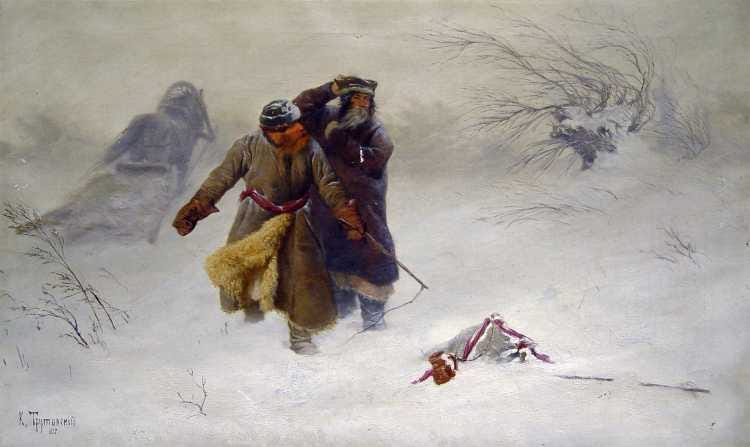
There they stood, fat and thin, very Chekhovian, shining torches in each other’s mugs, squinting, silent, breathing steam, bearded, all snow-covered. The thin one wore a short sheepskin coat and a fur hat. The fat one was enrobed in a whole bearskin with the head and toothy maw — you wouldn’t tell right away if it’s a man or a leshák5 standing before you. The wind whistled, the environs hummed, the birches crackled, their frozen twigs a-tapping. The fellows took turns shining their torches on the hut, nodded to each other, stoically, manly, and started digging it out, throwing snow to the sides. And dug they for a long, long time, puffing and panting, sweating up, but reached the window at last. They grabbed the shutters together, one on the left, the other on the right, somehow managed to fling them open, and climbed inside.
When the fat one was climbing in, a fiasco occurred...
— Yak-smackin’ babai!6 — he bellowed.
— What?
— Yak-smackin’ babai, I said!
— Eh?
— I’m stuck fast, mate.
— Press on, then.
— I’m telling you, I’m stuck!
— Well, draw in your belly and press on.
— Feck-n-thump!7
The fat one exhaled with all his might. The thin one pushed against him with all his vigour. Then both of them tumbled head over heels into the hut.
The thin one fell on top of the fat one, both enveloped by darkest darkness like in the chort’s betwixt-buttock regions. They gathered their wits, rose, closed the window, took out their torches again, and looked around: utterly barren hut, no soft, comfortable, gold-embroidered divans, no table with a magic tablecloth8 laden with delicacies, no samovar9 for a cuppa, no vodka, no hot baths, not even a looking glass. Even the stove was buried under snow. Well, at the very least, the wind wasn’t wailing, the birches weren’t cracking — it was completely silent — only the floorboards and the fellows’ bones were creaking, and their heads were still a-ringing.
So they stood there, blinding each other with their torches, examining one another.
— Human? — asked the thin one.
— That’s right, — replied the fat one.
— I’m human too.
— I can see that, mate.
Silence.
— Where are you from? — the fat one continued.
— From Tulubaika.
— Oh, I’m from Tulubaika, too!
Silence again.
— Really? — said the thin one, surprised.
— Very much really.
— And where are you headed, if I may ask?
— Well, to Tulubaika.
— Uh-huh...
The thin one took off his hat and scratched the back of his head.
— I was hoping you’d show me the way, — added the thin one.
The fat one was perplexed.
— Whither? — he inquired.
— To Tulubaika, — the thin one mumbled.
— To Tulubaika? But you’re from there yourself, aren’t you? — the fat one exclaimed in surprise.
— Well, so are you.
— Ha-ha! But I don’t remember the way, mate. That’s the thing. Do you know what I mean?
— Uh-huh… I don’t remember either... — said the thin one and sighed heavily.
They stood there, frowning, spinning their tangled thoughts as if on a spindle.
— And who does remember? — asked the fat one.
— Only God knows, — answered the thin one.
— To Bumfuck-Nowhere10, then turn left, Goddie said, — the fat one quipped.
The thin one’s eye twitched, but both fellows smirked, meaningfully so, with a hint of bitterness, sighed, fell silent, looked around, took off their rucksacks, and decided to sit down.
The fat one took a thermos out and asked:
— Coffa?
— Won’t say no to coffa in an hour of need.
The fat one poured the coffa into cups, inhaled a lungful of its sobering vapours, gasped with joy, sipped the beverage. Warmth spread through his body, his cheeks flushed — pure baldeige11, in a word.
— And who might you be? — asked the fat one.
— I might be Venyamin Patrikeyich.
— Wow. Right...
— ... And yourself?
— Maximilian, or just An.
— Eh?
— Eh? An, I said.
— An?
— Aye.
— And why “just An”?
— Because of my tongue-tied pops — he couldn’t pronounce the letter M, old bastard, so that’s what he called me, to keep it simple.
— I see...
They sat there, drank coffa, savoured the moment as their souls were covered in goosebumps and trembled with pleasure. It’s always good to have a chat with a fellow human, even if it’s not yet clear what manner of character is in front of you.
— Been walking long, Venyamin Patrikeyich? — asked Maximilian.
— Aye, quite a while, about ten years. And you, Maximilian?
— Oh, I don’t count the years. It’s not a prison after all. Ha!
Venyamin Patrikeyich frowned; a light surprise with a hint of spice appeared on his face. Well, he thought, it’s a matter of perspective. There may be no walls or bars, but it doesn’t seem to make one any freer.
— I’m a free man. I go where I want, — said Maximilian. — Fancy a bublik12?
Maximilian (whom the narrator, by the way, unlike Maximilian’s dad, can call by his full name since the narrator can pronounce the letter M) pulled out a string of bubliks from his rucksack, smooth, round, neat, the holes all in a row. He took one off and handed it to Venyamin Patrikeyich.
With trembling hands Venyamin Patrikeyich took the bublik, bit into it, relishing the noble dough — felt so good that tears almost welled up.
Thus they sipped hot coffa, chewed loudly, looked at each other, grinning from ear to ear, content, but with a speck of tension.
— It doesn’t really matter when I left — the important thing is that I’m going back, — Venyamin Patrikeyich declared with special significance.
Maximilian looked at him, munching on a second bublik (or maybe a third, as you can’t keep track of him — he’s gobbling them up like a beaver), and nodded with full empathetic understanding.
— And why did you leave?
Venyamin Patrikeyich fell silent and frowned. The hot coffa made him drowsy; he felt he could fall asleep any moment. He stroked his beard wet from the melting snow, pondering, as if grinding a thought in a mill mortar.
— To seek Istina, Maximilian.
— To seek “ughstina”13?
That pronunciation tickled Venyamin Patrikeyich’s ear, gently, like a feather.
— Istina. The very one.
— Is that the one with a capital letter or a small one?
— Listen closely, — said Venyamin Patrikeyich, raising his hands skywards, looking in the same direction (at the black ceiling, by the way), and discharged a word, — Istina.
— Oh, I see... With a capital letter then.
— The most capital of them all.
Maximilian slurped the coffa, clicked his tongue, driving the coffa liquids through all available receptors, relishing the aromatic blend.
— So, did you find her, Istina?
Venyamin Patrikeyich glanced at him from under his brows.
— What do you reckon, Maximilian?
— Well, I reckon you didn’t, — Maximilian replied, spreading his hands.
Venyamin Patrikeyich nodded silently and continued chewing his bublik. He consumed it in sixty-degree segments — as much as his jaws could handle — straight to the hole, turning the bublik into a horn. This bublik-eating technique seemed to appal Maximilian to the point where his eyebrows arched up in horror. “Well, well,” he thought, “that’s quite a soulless attitude you’ve got there towards the bublik, mate.” And to put an end to this crime against humanity, he decided that the dialogue must absolutely be continued and his interlocutor’s mouth be busy with words rather than the bublik.
— So since you didn’t find it, why are you going back? You should keep going and searching further. Don’t give up, they say, aye?
As planned, that distracted Venyamin Patrikeyich from munching on his bublik and he froze (not from cold, the hut was alright), falling out of time for a fraction of a second. Maximilian’s question, you see, triggered in him inevitable cognitive storms, into vortices swirling. He paused for a score of seconds, winced and blinked.
— The way it happens, Maximilian… — said Venyamin Patrikeyich and inhaled, nearly coughing. — Let’s say there’s Tulubaika, or Tmutarakan, or the Boonies-Goonies, or, pardon my French, “Bumfuque-Nowhere”14, places that aren’t half bad, quite ordinary to the unknowing man, but that’s not even important, because at first glance they simply exist and there’s nothing special about them, except for themselves.
— Aye, preach.
— And so that unknowing little man is born, crying, grumbling, discontent, starts running around the area to explore his native space and then thinks, is this really all? Right here, past the open field, by the old birch tree, is the boundary of my world? “My dear soul feels cramped in such conditions,” the little man thinks. “It yearns to fly, not to sit in a cage, to soar and glide over the expanses, for I am not really a little man, but a great man, and my soul knows no bounds within the universe, for it is the universe. It must see the world, know itself, gather Istina bit by bit.” Well, and since the universe has no boundaries, Istina can’t be concentrated entirely in one small plot of land like Tulubaika, can it?
— Sure it can’t, Patrikeyich. Logical-mathematical, that.
— And so, this great man rises in the morning, laces his lapti15, and sets off far, far away. He wants to escape; he walks a long way across the earthly expanses to see the world and to show himself. He visits Belovodye, the Land of Chud’, makes his way to Shambhala16, walks hand in hand with someone gorgeous through a nighttime Mediterranean city, and he almost touches it, Istina, but it eludes him and is still nowhere to be found. He descends into dungeons, drinks chai with Satan, plays cards with Hades, khorovods with Mara17, lectures demons on emotional intelligence. And meanwhile, no matter what wonder he beholds, be it the palaces of Semiramis, the Great Wall of China, the pyramids of Cheops, or the Firebird singing arias18, there’s still emptiness inside. He sleeps hugging his knees, barely reflects in the mirror in the morning, goes for walks in the park, touches the grass there, wanders, scuffing his soles, but the emptiness doesn’t go away until he realises what needs to be done.
Maximilian cringed from such philosophical excesses.
— Mate, you sure went off the deep end there. Now I won’t be able to sleep a wink. Therefore, I declare — we need a drink. Gotta sterilise the old noggin from these dastardly thoughts, — he said as he rummaged through his backpack for a bottle. — Fighting suicidal notions with a bit of chemistry.
— Bite your tongue, Maximilian.
— Me? You bite yours. Don’t worry, though. We’ll fill your emptiness right away, mate, — said Maximilian, filling the ornate shot glasses. — ”Realised”, he says, “what needs to be done”! Unbe-fuckin—
— To Tulubaika! Need to return to Tulubaika, Maximilian. Bojemoi! “Suic”... — Venyamin Patrikeyich said in a voice electrocuted with emotion and bit off another thirty-three degrees from the bublik. — I’m not even able to say it...
A shiver scraped across the back of Maximilian’s head. He looked at Venyamin Patrikeyich, how his jaws move, creak, grind his bublik, and held out one of the shot glasses to him.
— No alcohol, Maximilian, — Venyamin Patrikeyich answered, chomping. — I’ve enough spirit of my own.
— Oh, come on, mate, there’s barely a louse-piss worth of alcohol in there, — Maximilian laughed, showing the bottle to Venyamin Patrikeyich. — You haven’t tried anything like this yet — my granny’s recipe, an infusion of pine resin, moles, and the secret ingredient. Family recipe. Do you know how hard it is to get moles nowadays? I won’t even mention the secret ingredient. One sip, and your ughstina will strip naked before you. The main thing is not to go blind from what you see, however. Our Tulubaika folk know their stuff. Let’s knock one back, and the road might just open up before us, aye? — everything in the world is connected, after all. The Tulubaika recipe knows the way home. It’s how I go. Without it — I would’ve been lost long ago.
Venyamin Patrikeyich looked at the bottle where pickled moles and other unknown matter floated in the murky waters, grimaced, fell silent, twisted his thought into a knot. In the end, he waved his hand at it.
— Just one, perhaps, — Venyamin Patrikeyich mumbled and took the glass. “Never drank a mole,” he thought.
Maximilian cheerfully raised his drink in the air, scratched the back of his head with the other hand, and said:
— We need a toast! You go.
Venyamin Patrikeyich hesitated, inhaled-exhaled, melancholically glanced through the liquid, and spoke:
— Some things, Maximilian, are only visible from afar. We humans have very developed farsightedness. Until you step back far enough — you won’t see the bigger picture.
— Well, to farsightedness!
Venyamin Patrikeyich nodded. The glasses clinked, the infusion streamed down their throats.
— Ooh, sheer baldeige. Haven’t sat like this in a long time.
Maximilian sat content, his cheeks reddening, eyes shining. His drinking companion, meanwhile, grimaced, his mug all scrunched up, his hair standing on end.
— Forsooth, Maximilian... Forsooth...
Maximilian chuckled, patted Venyamin Patrikeyich on the shoulder, took out another bublik, and began to work on it carefully, along the contour, circle by circle, without breaking it, so that the hole would remain a hole for as long as possible — the hole must be respected, it’s the most important and tastiest part of the bublik, a delicacy after all. Why is it there otherwise? Meanwhile, Venyamin Patrikeyich sat, staring at the floor through the bottom of the shot glass and observed the blackness glimmering.
— And where are you coming from? — Maximilian asked him.
— From where?
— From where, yeah. Geography and whatnot.
— Ah, from the North.
— Oho, and I’m from the Souths.
Venyamin Patrikeyich, not understanding the point of the question, nodded in agreement.
— Well, here we are, met up, — Maximilian said.
No response followed.
— Our bastardous destiny brought us together, as they say, — Maximilian continued. — And do you know what that means?
— It’s apparent that we’re both destiny’s fools, Maximilian.
— Oh, you don’t understand anything, Patrikeyich. It’s painfully obvious that you reaching Ughstina is like trying to get to Beijing doggy-style.
Darkness descended upon Venyamin Patrikeyich’s face, and he glared maliciously at his newly acquired comrade.
— Don’t be cross. Look, I’ll lay out the arithmetic for you now, all neat and tidy. I was good at geographics and geometrics in school, you see, — Maximilian began enthusiastically, drawing figures in the air with his hands. — You’re coming from the Norths, I’m from the Souths. We have both been going to the same place in opposite directions. And suddenly — bam! — we met. Do you know what I mean?
— I do not, Maximilian, — Venyamin Patrikeyich sighed dejectedly.
— That we’re closer to our goal than ever before, of course. For this, I think, we must drink! — Maximilian exclaimed, so loudly that even the soot from the ceiling of the hut showered down.
He reached for the glass but Venyamin Patrikeyich wouldn’t give it up.
— I’ve had enough. Your “chemistry” isn’t helping. It’s only getting worse.
“Eat another bublik,” Maximilian wanted to say, but stopped himself. “I’m not going to waste my precious bubliks on you, mate.”
— I’m going to sleep. I’m tired. A long road lies ahead, — said Venyamin Patrikeyich, lay down, turned away, tucked his legs in.
— Aye, to hell with you then.
— Good night.
— Jolly good one, mate.
Maximilian stared at him for a minute, grinned, put the food and drinks back in his rucksack, wrapped himself in his bearskin, and carefully lay down next to Venyamin Patrikeyich, slightly embracing him (to keep the warmth, of course).
— What’s this all about? — Venyamin Patrikeyich protested.
— To avoid freezing, the first camping rule, — Maximilian said and threw his arm over Venyamin Patrikeyich.
— Well, you watch yourself…
They lay, warming up, trying to fall asleep. Barely audible, the winds raged outside, whistling, inviting them to come out and be torn to pieces, tapping on the roof of the hut with birch branches — come out, wanderer, come out!
Venyamin Patrikeyich had similar hurricanes in his head, only thinkering ones, the very same that are with him day and night, from sunset to sunrise, in sleep and in wakefulness, whistling, hitting him on the head with branches (amen). In these raging reflective storms, all sorts of things happen — it throws him about so much that it sometimes makes him nauseous: along a slippery path from existentialism to nihilism, through absurdism astride a snake that eats its own tail at the speed of light to meet Istina. Until suddenly the ontological police stop him, ask him to present his documents only to find out that the speeding violator has no papers, no passport to confirm his identity, no driver’s licence, no registration for the snake. The violator scurries away into an open field and hides in the pulsating oat dunes that stretch from one horizon of the universe to the other. And the violator immediately realises that he’s completely and irrevocably lost, lowers his head and the banner of all hope and wanders alone through the field until he meets the lass named Istina who starts khorovoding around him. She flashes before his eyes every few precious moments, waving her hand and immediately flying off into the distance, giggling. Red cheeks, merry eyes, all dressed in a kokoshnik, a sarafan, and with long braids19— unspeakable beauty, in a word. She grabs his hand, takes out a chintz hanky embroidered with neat letters, spreads it out right in front of his mug, and as soon as he starts reading — “ailulu tululu...” — she immediately — *phew!* — puts the hanky away, drops his hand, laughs, and grasshoppers away, blending in with the surrounding reality, and so on in a circle. The oat field trembles and transforms, the golden spikelets swelling, softening, until they bloom into pink orchids. Then, after the violator has already lost interest in what she has embroidered on the hanky in golden letters, Istina throws off her kokoshnik and takes off her sarafan. She rushes around the orchid garden like a madwoman and her clothes become less and less until she is left in a single translucent shirt showing “almost” everything. The orchids pulse and move unfurling their petals, then tightening, then blossoming again; the labellums pulse, too, their columns twitch from time to time; the heavy floral perfume thickens the air, their scent changing from sweet to musky as they open and close. With an unwavering gaze, spellbound and embarrassed, the violator gawks at her and then with one swift movement, she throws off her shirt too, baring her breasts and her other — rather androgynous — charms down below that, in fact, too, bloom into a peculiar living orchid. The violator flinches at such a delicate turn of events, squeezes his eyes shut with all his might, stumbles, and almost falls. All the while, Maximilian breathed loudly right in his ear.
— What are you thinking about?
— Huh?
— What are you thinking about? I see you’re dozing, can’t fall asleep.
— About Istina.
— Ah, your ughstina again. Of course.
Once again, at such a pronunciation of this sacred word for Venyamin Patrikeyich, he cringed. It felt like a knife in the groin.
— Well, don’t worry, — Maximilian added. — We’ll crack on at dawn.
— Huh?
— Huh?
— I think I’ve already cracked.
— What?
— That.
— We’ll crack on for your ughstina at dawn, I say.
— “At dawn”. Funny. We’ll be lucky if it dawns at all.
— I feel it in my gut that it will dawn.
— Sollie hasn’t been seen lately, so I’ve already forgotten what a dawn is.
— And I’ll tell you: it’s like a shining orange hanging in the sky. Its beams feel warm, pleasant, and tickle the skin. In Tulubaika, it’s like Philadelphia — always sunny.
— I don’t remember that.
— Stir your memory then.
— Nothing to stir there. You stick your hand in — something will chop it off. Sleep now.
— Oh, you’ve got a good wellful of gloominess in you, mate. One can scoop it up with buckets.
— The well is deep, and one can’t reach the bottom.
— Aren’t you tired, mate, of digging this well deeper?
— . . .
— When you get to Tulubaika, take a break or something. Go to a kabak20, drink a couple shtofs21 of beer, and play cards. There’s plenty of that stuff in Tulubaika.
— Sleep already.
— Oh well… “Sleep already...” Bo-o-ring.
Maximilian sighed and shut up at last. “Chronic philosopher,” he thought. “What can you expect from him? You need a proper mademoiselle, not your ughstina.”
Immediately, images of long, endless tables appeared before him, laden with victuals, drinks, wines, such as, for example, the legendary Tulubaikan Riesling, sour as samogón infused with lingonberries, cherry plums, and lemon peels but with such a pleasant aftertaste on the tongue and in the throat and a soothing sediment in the belly that if it were vinegar and not wine, it could be forgiven, yet it was wine, real wine, from real Tulubaika vineyards planted on the banks of the Tulubaika River, far from tall birches, so that the grapes would be filled with sun, would swell, and the naked Tulubaikan maidens would knead them with their angelic tender feet, pour the juices into barrels, and then bury those barrels in the ground, so that the wine would mature, absorb the spirit of the Tulubaikan land and its filigree fabric of time, and then, when the time came, they would dig up the barrels, pour the wine into bottles, cork them, and put them on the table, a long, endless table, at which all the inhabitants of Tulubaika would gather, from small to great, including, of course, Maximilian himself, and they would drink this wine, and they would eat Tulubaikan victuals: rye bread baked from flour ground in an old mill, marbled beef raised in Tulubaika, fed with beer and chestnuts and then roasted on a spit over a fire made with Tulubaikan wood, salted cucumbers and sauerkraut grown in Tulubaikan beds, apple pie made from fruits picked from Tulubaikan apple orchards, and much, much more. And songs would sound, old, good songs that their grandfathers and great-grandfathers used to sing, and they would dance to these songs until they dropped knackered. “That’s what Tulubaika is like,” Maximilian thought, “and not these bottomless wells of yours.”
— Say, Patrikeyich, can you play accordion? — Maximilian asked, but there was no answer, for Venyamin Patrikeyich had already fallen into a deep sleep and was snoring like a hog (the hedge one).
. . .
In the morning, or rather by noon, it really did dawn, which surprised both of them, emboldened Maximilian, and slightly offended Venyamin Patrikeyich despite the favourable development of events. “How could this be — it dawned? Where has such a thing been seen?” The clouds, however, not paying attention to his convictions, bid their adieus and eloped far beyond the horizon; the wind died down; and Sollie, that celestial orange, peeked out, its cheeks shining, its fiery smile sparkling, and wishing them a pleasant journey. Its beams reflected off the snow and blinded the eye but didn’t warm much... “Well, at least there’s no blizzard, and for that, thank you,” he thought.
Venyamin Patrikeyich walked, listened to the curious stories from Maximilian’s hedonistic adventures and as usual looked around (you never know). Sometimes he plunged one foot into a snowdrift and wondered how Maximilian managed to walk straight and steady. He walked in front and checked the density of the snow with a long cane before stepping. Venyamin Patrikeyich followed exactly in the footsteps left by Maximilian but for some reason he often fell through, and was left staring at Maximilian’s bearskin cape with its head thrown back. He didn’t have a good look at it at night, but now it was in front of him the whole way. The expression on the poor bear’s face was, to put it mildly, like that of an utter village idiot who was dropped headfirst on a hard floor as a child, placed under a falling brick from the sky, and had new infusions tested on him before they went to production, whether made from frogs, snakes, or moles — eyes slanted, mouth agape, bouncing with each step, a masterpiece of taxidermy, no less.
For a long while Venyamin Patrikeyich thought about his own affairs until suddenly Maximilian said this:
— And, by the way, no matter what anyone says, orgies in Tulubaika are the best, Patrikeyich.
— Huh? What?
— You probably remember, the whole village then on Solstice? It became a tradition, by the way.
— I don’t recall that, — Venyamin Patrikeyich said, frowning.
— You were probably already legging it after your ughstina then and missed everything. But don’t worry, I’ll tell you... So, that day we uncorked a couple of barrels of wine and started lighting the festive bonfire. Everyone was merry, throwing more and more firewood into it, and our tractor driver Semyon (maybe you remember him), already sloshed to the gills by that time, dragged a canister of diesel fuel from somewhere and poured it right there — so he did, for real. Oh was it burning, mate, a real fuckinn inferno right up to the heavens so that the glow was seen in the neighbouring villages: Bultyshka, Bekarikha, even Orekhovshchina. They thought we were on fire, imagine. And well, you understand, jumping over such an attraction is chanceless. Your clothes will catch fire and you won’t have to go to the crematorium no more. A real bargain for some, I must say. But most still want to have fun because you can’t go against traditions, can you? Therefore, everyone decided to take off their clothes and lead khorovods and jump like that, straight through the flames, in their birthday suits, both lasses and lads, no one was shy. We ran, jumped, sang songs, laughed, shook our bodies, shone with our curves, bits and bobs, and other charms of our figures. And the figures in Tulubaika — ooh! The gene pool, as they say, is ho-ho! No Greek muse has such roundness. And Denis, the priest’s son whom everyone called Dionysus, turned out to have such a hose; he should’ve gone into fuckinn firefighting with it.
Venyamin Patrikeyich even winced, and the image of the polymorphic Istina without clothes, with fine roundness and with orchidaceous bits and bobs flashing outwards appeared before him again. He squeezed his eyes shut, trying to evict the image from his consciousness, but it wouldn’t disappear until he pinched himself on the cheek.
— What a disgrace, — said Venyamin Patrikeyich resentfully. — You’re making it up. There was no such thing.
— Oh, there was. While jumping naked through the fire everyone got sweaty and went to bathe in the river. And there... If you only knew what we did.
— You’re lying.
— I swear on my tooth, the Kama Sutra was invented in Tulubaika. I’d tell you but I’m afraid you can’t listen to such things, Patrikeyich — your ears would curl into tubes, or worse. Ooh, now that I remember, I get goosebumps down my spine. I’ve been to Europes, to Americas, to the best brothels in Thailand, you name it — I’ve never seen anything like it anywhere. Tulubaika is truly special.
— Come to your senses! There has never been such a thing in Tulubaika and there couldn’t be. No decent person in the village would allow that bacchanalia.
— It was, it sure was.
Venyamin Patrikeyich refrained from answering.
— Denis then even joked that we should repurpose his pops’ little church into a temple of Dionysus, ho-ho.
— Tulubaika is not a circus or a brothel, — Venyamin Patrikeyich grumbled.
— Tulubaika is whatever you want it to be, mate, — Maximilian parried.
Plugging his ears by sheer willpower, Venyamin Patrikeyich kept silent and tried to think of his own affairs again. He knew precisely what Tulubaika had been like and what Tulubaika awaited him and it was nothing like the way Maximilian described it. There was no garden of earthly delights, no island of the lotus-eaters, no cradle of voluptuousness, no custard shores by the river Tulubaika, and, bojeupasi, no collective fornication to speak of. The people in Tulubaika had always been kind, thoughtful, spiritual, valuing order, justice, God’s law, apparently knowing something about Istina, which he, Venyamin Patrikeyich, had missed in his foolish youth when he ran away lured by “hidden meanings” and “readings of the world between the lines”. As for risqué activities — at most going to the banya22 together, steaming, relaxing the body and spirit, but is that really a sin? Tell me, reader, is banya a sin?
— ... and I thought, — Maximilian continued, — I’ll return to Tulubaika and write a book.
This cheered Venyamin Patrikeyich up and straightaway pulled him out of the trance he’d slipped into whilst trying not to listen to the unrelenting Maximilian.
— A book? You?
— “The Adventures of Maximilian Bzdynkin23: Baldeige and Other Meanings” in three volumes, mind you. It’ll sell millions of copies, put your religious-philosophical scribbles to shame, and teach folks a thing or two about life.
— I see you’ve thought it all through, — said Venyamin Patrikeyich with a spasm of sarcasm. It bears mentioning that he could make any face he wanted (even to tuck his tongue out) while trudging along behind.
— You bet!
— If Tulubaika had bored you so much that you left, why are you heading back there?
— So I’ll be teaching the youngsters how to live. I’ve gotten old now, haven’t I? Entering, as they say, my sage phase. I’ll sit on a tree stump in the middle of the village, handing out advice, egging on the little Tulubaikan tykes, steering them onto the right path of life.
— You? Old? — Venyamin Patrikeyich ironised, but thought something else to himself (he wouldn’t want you to know).
— You bet, quite old. Got hangovers now and all that. Here, listen to my knees cracking.
Stopping, Maximilian lifted one leg, moved it in circular motions clockwise, and the cracking echoed through the grove.
— Indeed, — smiled Venyamin Patrikeyich.
— That’s what I’m saying. But that’s the least of it, mate. I’ve realised something else. As you said, “mankind suffers from short-sightedness”.
— Far-sightedness.
— Aye, don’t matter. Mankind sees poorly, needs special specs, or maybe one of them magnifying glasses, willy-nilly.
“Willy,” thought Venyamin Patrikeyich, giggled, and immediately chided himself in his mind.24 He tensed up and quickened his pace to hear better but Maximilian stopped and turned around, looking him straight in the face, which made Venyamin Patrikeyich flinch. Did he say it out loud?
— Now, Patrikeyich. Let’s say there exists Baldeige with a capital B, transcendent ecstasy, if you wish. That’s how I’ll start the book. So you live, your stomach wants one thing, your brain — a second, your male organ — a third, and your heart — a fourth.
— You seem to have forgotten the spirit, Maximilian.
— Don’t interrupt. I’m developing a thought here, mind you. So, I lived in Tulubaika, didn’t worry, had earned my medals in hedonism, erotica, gambling and all that decadent stuff, but suddenly decided that it’s all boring there with you lot — something’s just not right. Not enough, not enough of everything, and I wanted more, and something new, something... something unlike all the previous stuff, do you know what I mean? Well, I thought, chort with you, I would go conquer the globe. There’s still an unploughed field there in terms of Baldeige. I’ll test my luck, so to speak.
— And did you? Test your luck?
— Oh, did I ever, mate... But luck, it seems, grows tired of being tested. You walk the world, but what are you looking for? No clue. The million-lucre25 question, as they say.
— Baldeige, apparently, — Venyamin Patrikeyich quipped.
— Ha, baldeige is all well and good, but which one exactly? That’s the question.
— Is there a difference which Baldeige?
— We-e-ell, don’t even get me started, — Maximilian broached. — The difference is so grand that... You know, my philosophical apparatus wouldn’t suffice to express it.
“No surprise there,” thought Venyamin Patrikeyich.
— But tell me, does it make a difference to you which Ughstina you follow?
— Istina is one and there can be no other, — replied Venyamin Patrikeyich, pronouncing Istina with emphasis on how it should be pronounced, not how Maximilian did that again.
He stood in front of Venyamin Patrikeyich with his hands on his hips.
— Well then, describe it to me, this Ughstina of yours.
— Istina, — Venyamin Patrikeyich corrected sharply.
— Doesn’t matter, ughstina-shmufstina. What is it then? Do you know, huh?
Venyamin Patrikeyich faltered at such attacks, grew angry, like a wolf driven into a corner, and with a voice trembling from the energies seething in his body, replied:
— I think so, yes.
And Maximilian attacked:
— You think or you do?
Venyamin Patrikeyich’s arterial pressure rose, thoughts began to pulsate in his brain, his head spun, images of Istina flashed before him in her most diverse guises, with all her primal trappings. He blinked loudly and said:
— I would tell you, Maximilian, but I’m afraid “your ears would curl into tubes”.
— Oh, spare me. You don’t know, and no one knows. Chekhov didn’t know, Tolstoy didn’t know — so they said to each other, famously. That’s why we wander the forests, like in a fairy tale, “Go I know not whither and fetch I know not what”.
— It’s a personal journey. Istina can’t be expressed in words. It doesn’t want to be known and subjected to description. It shuns all human efforts to encase it in our foul language.
— Exactly, Patrikeyich. But Baldeige is just the same. You recall it and your cheeks and ears blaze. It’s a thing you can’t tell your grandkids about; to your lawyer — maybe. It is attained, like Ughstina—
— Istina! — snorted Venyamin Patrikeyich.
— ... through personal experience, — Maximilian frowned, — step by step. Somewhere you smoked hashish to oblivion, somewhere you broke a fine mahogany bed with a fine maiden, somewhere you gambled away your cat at cards, somewhere you nearly drowned in wine, almost died. But this is the way, you know. As the ancient Tulubaikans said, Ughstina is in wine.
— Romans.
— What Romans?
— It was the Romans who said that, not the Tulubaikans. In vino veritas. And grapes never grew in Tulubaika. How could they in such latitudes?
— Your Tulubaika is wrong, Patrikeyich. Seems your wanderings haven’t cured your short-sightedness, only made it worse. You’re going back too soon, should’ve wandered more, aye? I told you, you’re as far from hooking up with Ughstina as you’re from blowing yourself off.
At this moment, Venyamin Patrikeyich’s brain and heart became coated with a black crust resembling solidified lava. His brows furrowed, his fists clenched, his legs trembled.
— Now say “Istina”, — he growled through his teeth.
— Ughstina, — Maximilian said carelessly.
— Say “Istina”, say it properly, with the “I”! — insisted Venyamin Patrikeyich.
— Ughstina?
Growling, Venyamin Patrikeyich rushed at Maximilian, swinging his arms. He deftly dodged it, and the attacker fell face-first into the snow.
— Oi-eh, this is new, Patrikeyich. Set upon a mate with your fists? Over some Ughstina? Not a sacred bone in your body.
All covered in snow, his mug red, Venyamin Patrikeyich went right berserk, leapt out of the snowdrift and sank his teeth into Maximilian’s leg, but missed the flesh, only biting the thick cotton-stuffed trousers. Maximilian tore free from his weak grip, laughed, and ran away through the snowdrifts up the hill between the birches, waving the degenerate squint-eyed bear-head with its protruding tongue.
— ISTINA! Say it!
— Ugh-ugh-ughstina! — he teased as he fled.
Venyamin Patrikeyich rose from the snow and ran after him.
— Freak, swine! Say ISTINA! Heathen.
— Ughstina! Ugh-sti-na! — Maximilian drawled, now and then hiding behind birches and playfully peeking out from behind them.
The hill grew steeper, the birches sparser. Maximilian with rosy cheeks bounced back and forth like a ball. Venyamin Patrikeyich with a boiled crayfish face ran after him, panting, stumbling, shouting insults and demanding he pronounce Istina correctly. His heart pounded like a locomotive piston at full speed, steam coming from every crevice. He grabbed birches, leaned on them, pulled himself up, dragging himself Maximilianwards, snatched branches and threw them, but they never reached the target, falling into the snowdrifts.
— You fuckinn bastard, come here, you piece of dogshit! ISTINA! Say ISTINA! Come on try and fuck me up!
Merry, laughing, Maximilian would stop, wait for Venyamin Patrikeyich, then break away again. It grew harder for both to advance, the hill seemed to gain an ever greater incline as if leading them into the pure blue sky with smiling chubby-cheeked Sollie at the centre.
— And you eat bubliks wrong, by the way! — shouted Maximilian to Venyamin Patrikeyich, who now looked and sounded like an old sick mongrel with tuberculosis.
He had already lost his hat and gloves, his long black hair with streaks of grey stuck to his face, got into his eyes, clung to his beard, sweat streamed down his body, snot hung from his nose.
— You goddamn wanker. GO TO HELL, come on, idiot, I’ll fuck you and your entire family up. FUCKING DOGSHIT PUTRID SLOB, you turd, bitch, bastard, COME HERE you scoundrel, scum, shitestain COME HERE, you FUCKING ARSEHOLE.
Here Maximilian discovered that the hill in front of him ended, and it ended at none other than a cliff.
He quickened his pace and, sinking into the snow, grabbing onto bushes sticking out from under the snowdrifts, he climbed upward and paid no attention to Venyamin Patrikeyich crawling behind him.
At the edge, when new horizons opened up before him, Maximilian was dumbfounded, his lower jaw dropped, his eyes rounded, his ecstatic heart shook even faster, exhilarated. There, among the forests, lost in the snow-covered valley and shining brighter than Sollie itself, it sprawled — Tulubaika.
Wooden mansions several storeys high, adorned with filigree carving, were wrapped in soft white coats and towered over the streets. Their pointed roofs in colourful patterns were sprinkled with snow as if with powdered sugar. Above the porches with twisted columns, stove pipes smoked merrily. Among the mansions, on the main square, the golden domes of churches proudly gleamed. Their crosses, crowned with bullfinches, reached into the frosty blue sky. The chime of bells floated over environs merging with the festive hubbub and the inviting cries of merchants. Along the streets strolled festively dressed folk. Pretty lasses in downy shawls and embroidered kaftans26 walked. Daring lads raced on swift horses, whipping up snow-dust whirlwinds. Children squealed as they slid down icy hills and threw snowballs. Under the hunchbacked bridges, decorated with icy lace, the Tulubaika River ran, fast and never freezing. And on the shore, sprawling freely, the fair was abuzz. In the painted tents, samovars smoked, plump kettles sparkled, and bundles of bubliks hung.
Intoxicated by the fairy-tale vistas, Maximilian went completely limp and lost his vigilance. There it was, right in front of him — Tulubaika itself. He turned around to share what he had found, but right then snarling Venyamin Patrikeyich appeared and charged at him. Before Maximilian could say a word, both of them somersaulted down from the cliff cuddled up and screaming.
Right in the middle of the way, crisp breeze Boreas (bastard) caught the wanderers and carried them to Tulubaika.
thank you for reading droogi
and your unrelenting support of our work —
beams of appreciation!
The original Russian idiom “у черта на куличках” literally translates as “at the chort’s tussocks”, referring to the remote hummocks or islets within a swamp where, according to Slavic folklore, supernatural entities, such as the chort, were believed to reside.
“Holodrigue” is an English approximation of the Russian colloquialism “холодрыга” (kholodryga), a term denoting a bone-chilling, teeth-chattering cold. Normally a translator could render it as “bitter frost” or “extreme coldness” but that would lose the folkloric, visceral, almost personified quality of the original word, where cold becomes not just a condition but an aggressive entity that actively assaults the human body.
Direct rendition of “Boje upasi” (God save [me/us/thee]) for extra Russian flavour.
The phrase “without windows without doors” (без окон без дверей) is the beginning of a well-known Russian folk riddle format where listeners are asked to identify an object that contains things despite lacking obvious openings (the classic solution being a cucumber filled with seeds).
“Leshy” (леший), or a bit more regional and derogatory “leshák” (лешак), is a woodland spirit in Slavic mythology. Often depicted as a shaggy humanoid figure who can change size at will and become as short as a blade of grass or as tall as a birch. The leshy serves as master and protector of forest animals and can lead travelers astray, causing them to wander in circles.
“Yak-smackin’ babai” renders the Russian euphemistic expletive “ёкарный бабай” (yokarny babay). The first component, “ёкарный,” is widely recognised as a deliberate phonetic distortion of a far more robust Russian obscenity beginning with the letter “ё”: “ёбаный” (lit. fucked). The second element, “бабай,” has multiple etymological interpretations: it derives from Tatar or other Turkic languages meaning “grandfather” or “elder”; in katorga/prison argot, it referred to moneylenders; and in Russian folklore, “бабай” serves as a bogeyman used to frighten children (”Behave well, or the babai / babaika will get you!”).
“Feck-n-thump” renders the Russian euphemistic exclamation “Едрить-колотить” (yedrit-kolotit). The first component “едрить” is a deliberate mangling of “to fuck”, while “колотить” literally means “to pound” or “to beat”. “Fuck me sideways!” might be a decent alternative to express the same emotion.
The “magic tablecloth” is a specific artefact in Russian folklore with the supernatural ability to spontaneously serve abundant food and drink when unfolded.
The “samovar” (самовар) literally means “self-boiler” (from “сам” / self and “варить” / to boil), looks like a large metal kettle-like urn. Since the 18th century or so, the ritual of chai-drinking (чаепитие) around a samovar has constituted the quintessential expression of Russian conviviality, where conversations flourished for hours over endless cups of zavarka (concentrated chai) diluted with hot water from the spigot. The absence of this item from the abandoned hut says a lot: without a samovar, no proper home exists, only shelter.
“Хуево-кукуево” (Khuyevo-kukuyevo) is translated to “Bumfuck, Nowhere”, which, despite sounding quite different, are geographically the same thing.
“Baldeige” renders the Russian term “балдёж” (baldyozh), which means “euphoria or ecstasy”. It was first documented in dictionaries around the 1970s. The term emerged from Russian youth slang and underground / dissident culture during the Soviet era, expressing pleasure states often discouraged in official discourse. Etymologically “балдёж” derives from “балдеть” (”to be in bliss” or “to zone out”), which comes from “балда” (”blockhead” or “fool”), ultimately borrowed from Turkic languages (compare Turkish “balta” meaning “axe”). Joseph Brodsky used the term in his essay “Dedicated to the Spine” (1978) about his trip to Brazil: “The continental riff-raff get their knickers wet from this stuff, because — polemics whatever, a quote either from Feuerbach or from some other idealistic twat, grey hair and complete baldeige from the sound of his own voice and erudition”. The transliterated rendition of the word attempts to preserve both the phonetic character of the original and suggest its meaning through proximity to English “indulge.” The “-eige” suffix was chosen to approximate the soft Russian “ж” sound (similar to the “s” in “pleasure”) while giving the term a distinctive foreign, almost French-derived, quality in English. Its closest Russian synonym is “кайф” (kaif), another borrowed pleasure-term (from Arabic) that would later become ubiquitous in post-Soviet popular culture and is still widely used by young generations (at least the translator reckons as much).
The “bublik” (бублик) is an Eastern Slavic ring-shaped bread roll with a distinctive large hole, a gastronomic cousin to the bagel. Unlike its denser, chewier Western relative, the bublik is traditionally larger, lighter in texture, and possesses a glossy, almost glazed exterior achieved through a brief pre-bake boiling. In Russian, they were (perhaps are) often sold strung on a cord like beads, creating a portable bread necklace that features prominently in folklore and literature. The hole itself is considered by some to be the bublik’s quintessence — the absence that defines the presence — giving rise to the Russian expression “дырка от бублика” (a hole from a bublik) to describe something essentially worthless despite its promising appearance. Interestingly, this paradoxical formulation (the absence defining the presence) is close to Derrida’s notion of the “absent centre” in his deconstructionist philosophy, where meaning is created through difference and absence rather than through stable presence, as well as to the Buddhist śūnyatā (emptiness), where the emptiness or void at the centre of phenomena is what gives them their meaning, or, to be honest, setting aside all those, just Chekhovian revolution in literature.
In the original, the character deliberately mispronounces it as “Ыстина,” replacing the clear “ee” sound of the initial letter with the distinctively Turkic guttural “ы” sound (which has no English equivalent, but guttural “ugh” might be close) that exists in Russian, too, unlike in other Slavic languages.
A typical Russian rhetorical escalation when describing remote and supposedly bad locations. “Tmutarakan” (Тмутаракань) began as an actual historical principality in the medieval Kievan Rus’ as an outpost on the Taman Peninsula but evolved to symbolise the archetypal middle-of-nowhere. “Boonies-Goonies” (Быдло-Васюки) is a folksy colloquialism for the same place, etm. Geography, folks!
“Lapti” (лапти) is traditional Russian bast shoes, a type of footwear woven from strips of birch or linden bark and worn by Russian peasantry for millennia. Unlike leather boots, which signified prosperity, lapti marked their wearer as unmistakably rural and poor. The shoes lasted mere days under heavy use, giving rise to the expression “не лыком шит” (not stitched with bast), meaning someone more refined than appearances suggest.
Unlike the previous rhetorical sequence, this describes “good places”, or rather “geographical curriculum vitae for spiritual searching.” “Belovodye” (Беловодье, lit. “White-Waters”) is a legendary utopian land from Russian folklore, a paradise of righteous living, abundant harvests, and religious freedom that was believed to exist somewhere beyond Russia’s borders. Old Believers and religious dissidents spent centuries seeking this mythical realm in Central Asia, the Altai Mountains, and even Japan. The “Land of Chud” references the Chud’ (Чудь), a mysterious ancient people in northern Russian folklore, who, rather than submit to Christian conversion or conquest, chose to bury themselves alive, descending underground where legends claim they still dwell in hidden kingdoms. “Shambhala” is a pure spiritual kingdom hidden somewhere in Inner Asia, accessible only to the morally pure and spiritually advanced Buddists. In esoteric tradition, it represents both a physical place and a state of consciousness. But what about Tulubaika? Is it a “bad” or “good” place? No one knows, though might as well!
In Slavic folklore, Mara (or Mora) is a nocturnal spirit who sits upon sleepers’ chests, bringing suffocating nightmares (a likely etymological ancestor “nightmare”). Additionally, in Buddhist tradition, Mara is the demon-tempter who assailed Siddhartha with illusions and desires on the eve of his enlightenment.
In Russian folklore, the “Firebird” (жар-птица) is a magical glowing bird from a faraway land whose feathers blaze with golden or silver light and whose eyes sparkle like jewels. It plays a central role in numerous Russian fairy tales where heroes undertake perilous quests to capture it or retrieve its feathers.
These items collectively represent traditional Russian feminine attire. The kokoshnik (кокошник) is a distinctive semi-circular or crescent-shaped headdress, often ornately decorated with beadwork, pearls, or embroidery, worn on special occasions and holidays. The sarafan (сарафан) is a long, sleeveless pinafore dress. Long braids were the traditional hairstyle for unmarried Russian women and girls, while married women typically covered their hair.
A traditional Russian tavern or drinking establishment for the common folk dating back to the 16th century.
A unit of liquid measurement in Imperial Russia, equivalent to approximately 1.23 litres (or one-tenth of a vedro, if that’s easier).
A traditional Russian steam bathhouse, distinct from Western saunas or bathhouses. The banya typically consists of a small wooden structure with tiered wooden benches and a stone stove over which water is poured to create steam. The ritual involves alternating between intense heat sessions and cooling periods, often including aggressively torturous flogging with bundles of dried birch or oak or other branches to improve blood circulation and overall mood. Historically, the banya served multiple functions beyond hygiene (and now recreation): a place for childbirth, healing rituals, pre-wedding ceremonies, and various sorts of social bonding.
A surname that Russian readers would immediately recognise as comically vulgar, evoking a certain gaseous bodily function. The English equivalent might be something like “Toottleton” or “Brapson”, though naturally, no proper translator would ever resort to such undignified substitutions.
OK, here’s something important: The Russian original plays on “лупа-залупа” (lupa-zalupa), wherein the “лупа” (loupe/magnifying glass) clashes with the “залупа” (glans penis, bellend). This wordplay is the basis to a whole genre of Russian jokes featuring two fictional characters, Pupa and Lupa. The joke typically follows a formula: the two embark on some mundane activity, like collecting their wages. However, given their similar names, a mix-up occurs, and Lupa receives Pupa’s salary, Pupa receives Lupa’s, and the resulting verbal construction (“Pupa got Lupa’s” = “пупа залупа”) deliberately triggers the vulgar homophone. The translator’s rendering uses “willy-nilly,” a phrase of Shakespearean vintage (from “will ye, nill ye”). If we were to translate the original joke, we could do it this way: “Mr Willy and Mr Nilly are at the baths. Nilly drops the soap. Bends over. Behind him: Willy.” Translation theorists call this move “domestication” — reshaping source material to function within target culture norms while accepting Umberto Eco’s principle that translation inevitably means saying “almost the same thing.”
Lucre is a fictional currency often used in the author’s works. Similar to ruble (Russian currency) or any other currency but more lucrative in its name to emphasise its capitalistic nature.
The “kaftan” (кафтан) is a traditional Eastern European and Central Asian outer garment that dates back to at least the 13th century. It’s an ankle or knee-length coat that typically features a fitted upper body that flares gently from the waist, long sleeves, and front fastening with buttons, loops, or decorative clasps. Basic kaftans served as practical everyday wear for ordinary people, but elaborate versions with rich embroidery, fur trim, and precious metal adornments became status symbols among Russian nobility and royalty from the 15th to 18th centuries.
Droogi you gotta make a crash course on russian, like even the translation is wonderfull the actual one has to be "baldeige" level
really enjoyable read, I love this